
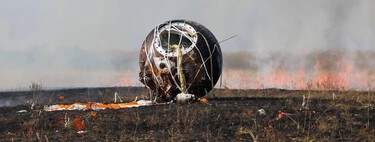
The afternoon is almost always quiet in the small Chaco town of Puerto Tirol , north of Argentina. On Thursday, that tranquility was interrupted by an object fallen from heaven. It appeared on a rural property whose owner promptly called the police. The authorities cordoned off the area while awaiting the arrival of the firefighters. Following this incident, all investigations began online.
What is known. The object measures 1.70 meters long and 1.20 meters in diameter . It is metallic, features a cylindrical shape, and is covered with carbon fiber or a similar compound material , suggesting it is likely a pressurized propellant tank , a piece of space equipment known as a Composite Overwrapped Pressure Vessel (COPV) .
<img alt="Russia sent 75 mice to space in a Soviet design capsule. All have returned except 10" width="375" height="142" src="https://i.blogs.es/2ab0b6/captula-animales/375_142.jpeg"/>When a satellite or a rocket re-enters the atmosphere, most of its body burns due to the pressure. However, these containers are designed to withstand very high pressures, which explains why some of them survive largely intact—albeit somewhat charred and frayed , as seen in the photos.
What is suspected. The first identification came from the Caribbean Astronomy Society ( SAC ) through a Facebook post. They confirmed that the object resembles a piece of a space vehicle, specifically a COPV . They pointed out that among the most recent launches, the main candidate for this object is likely a Chinese rocket that was launched just the day before.
Analyses of the trajectory seem to confirm these suspicions. Renowned astrophysicist and satellite tracker Jonathan McDowell corroborated the hypothesis, stating that the object is “probably” the tank of the fourth stage of a Chinese Jielong-3 rocket .
From China to Chaco. The private company China Rocket launched the eighth mission of its Jielong-3 rocket on Wednesday. The Y8 mission took off from a maritime platform at 07:56 UTC to deploy 12 satellites belonging to the Geely Future Mobility constellation, which provides positioning and communications services for the Chinese automotive giant Geely.
After deploying the satellites, the rocket’s fourth stage continued orbiting the Earth until 9:00 UTC the next day, when it was sighted disintegrating in the sky about 15 kilometers from Puerto Tirol . Most likely, it did not burn up completely, allowing the tank to survive the fall.
A questionable history. In recent years, China has attracted attention for several incidents involving falling space debris. One of the most infamous cases is that of the CZ-5B state rocket , whose central stage, weighing over 20 tons , is designed to reach orbit and subsequently fall back to Earth in an unpredictable manner within days or weeks.
However, this behavior is evolving. Both state and private companies are increasingly focused on their rockets’ capabilities to maintain controllable paths, ensuring they have some fuel remaining after deploying satellites.
The problem is not that. The real issue at hand is space debris . The Earth’s orbit has become a landfill, with a plethora of inactive satellites and rocket parts circling the globe. Due to atmospheric braking, many of these objects are gradually descending towards Earth. With the rise of satellite megaconstellations, an average of three significant pieces of space debris re-enter the atmosphere daily—often without any control.
As a consequence, incidents in populated areas are becoming increasingly frequent. In March 2024, a fragment of a battery pallet discarded from the International Space Station crashed through the roof of a house. In January 2025, a half-ton ring appeared in a town in Kenya . In February, several pieces of a SpaceX rocket fell near a city in Poland .
While Earth is vast—predominantly depopulated or covered with water—it’s only a matter of time before something serious occurs. As such, space agencies like ESA are advocating for a commitment to “zero waste” initiatives to enforce stricter regulations on their missions. Achieving a global consensus on this issue is critical.
Images | Llitory region
In Xataka | The fireball that crossed Spain on Sunday will not be the last one: with 8,000 Starlinks in orbit, it will soon become a regular occurrence.