
In 2022, Kenn Dahl faced a staggering 21% increase in his car insurance premium, despite enjoying a clean driving record with his Chevrolet Bolt. Frustrated, he sought the advice of his insurance agent, who suggested looking into his LexisNexis report . This data broker, based in New York, collects extensive information about drivers and sells it to insurance companies. Under the Fair Credit Reporting Act , Dahl was entitled to access his report, leading him down a path of unexpected revelations.
Upon receiving the report, Dahl was taken aback by its length and detail. Spanning a whopping 258 pages , over 130 pages were devoted to documenting every instance of driving by him and his wife over the previous six months. The report detailed 640 journeys , outlining everything from the start and end times to the distance traveled, and even noted patterns of acceleration and braking. The only missing element was the exact locations traveled.
Your Car is Cool
As revealed by a recent article in *The New York Times*, a growing number of automobile manufacturers are harnessing an array of sensors and systems to collect data on drivers—often without their explicit consent. Today’s vehicles are equipped with technology capable of analyzing driving behavior, which manufacturers both analyze for their research and resell for profit.
This massive collection of data on drivers has not gone unnoticed. For example, General Motors utilizes the Smart Driver OnStar system, which users can opt out of, but many don’t realize it’s activated by default. Drivers who have discussed this issue on platforms like Reddit and dedicated Chevy Bolt forums have expressed concerns over such unwarranted data collection.
Other manufacturers are also employing similar tactics. Kia’s Kia Connect system is designed to gather a “driver score” to tailor insurance premiums based on individual driving habits. The data collected purportedly rewards safer drivers by providing them with lower rates, yet it raises significant privacy questions.
Peugeot owners have reported similar issues, wherein a Private Mode feature can be activated to prevent data collection. However, this may also limit access to essential functions like connected navigation or remote vehicle control.
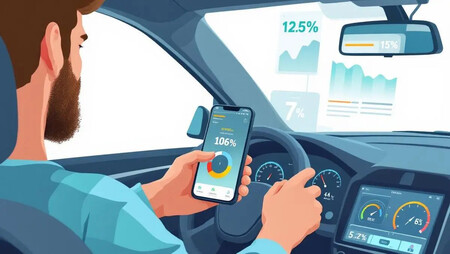
Kia Connect is a service that informs the driver of their “driver score,” aiming to offer personalized automobile insurance.
A study by the Mozilla Foundation in 2023 revealed that 88% of analyzed brands inferred additional details from the data they collected. Disturbingly, this included personal insights into users’ beliefs and sexual activity. Alarmingly, of the companies studied, 76% were found to be selling this sensitive information to other businesses.
The Good Thing About Tesla is that They Have Cameras. The Bad, Too.
Concerns about data privacy take on a new dimension with Tesla vehicles. Between 2019 and 2022, former employees shared sensitive videos and images captured by Tesla’s built-in cameras, including compromising situations involving customers.
For instance, one report describes how employees accessed footage of a naked man near one of the cars and, alarmingly, even scenarios of accidents involving children. These revelations highlight not only potential privacy violations but also the alarming ease with which such private moments could circulate within a corporate environment.
Tesla vehicles exemplify the scale of massive data collection . According to sources, Tesla records location data and driving nuances—ranging from speed to braking patterns—though the company claims it does not store this information unless it involves a crash.
Other data recorded includes infotainment statistics , such as navigation history or voice commands. While some functions can be disabled to limit data sharing, doing so often means sacrificing key vehicle features.
The European Data Protection Committee issued guidelines in 2021 to enhance control over personal data related to connected vehicles, urging manufacturers to minimize data collection. These guidelines emphasize the importance of local data processing and empower consumers to access, rectify, and delete their information.

While these privacy safeguards exist, compliance remains inconsistent. Recently, the Electronic Frontier Foundation (EFF) released guidelines for consumers seeking to understand what data their vehicles collect and how to prevent unnecessary sharing. As more drivers upgrade to modern vehicles adorned with sophisticated data-collecting capabilities, the potential for privacy breaches escalates significantly.