
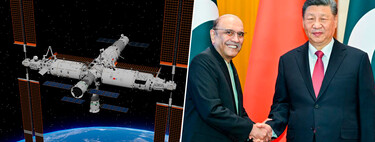
If the space race of the last century was decided on the moon, that of this century could unfold in a similar arena. The cosmos has once again become the great theater where the two largest economies in the world showcase their technological prowess , and China has been preparing an impressive series of developments to reshape its narrative in this space saga.
A little paint in the face. This tale has a definitive starting point: 1994 . It was the year China requested to join the International Space Station (ISS) program alongside other global partners, yet the United States vetoed its entry, maintaining that the nation was untrustworthy. Following this setback, China initiated its own manned space program, but another blow awaited in 2011 when the U.S. Wolf Amendment prohibited NASA from any form of cooperation with Chinese counterparts.
<img alt="A Pakistani astronaut at the Chinese space station" width="375" height="142" src="https://i.blogs.es/fbfc30/astronauta-pakistani/375_142.jpeg"/>Compounding this, China endured repercussions from a world increasingly reliant on navigation satellites . A significant incident took place in 1993 when the United States deliberately shut down GPS satellites that left the Chinese ship Yinhe adrift for 33 days. A further blackout in 1996 caused a GPS-guided missile from China to fail. Although China invested €230 million in 2003 to join the European Union’s Galileo satellite navigation system, it was ultimately ousted from this project.
From isolation to self-sufficiency. Rather than succumbing to isolation, China committed to constructing everything it had been denied, step by step. In 1999 , it launched the Shenzhou spacecraft. By 2003 , it became the third country—after Russia and the U.S.—to independently send a human into space: Yang Liwei aboard Shenzhou 5 .
In 2007 , China embarked on dual paths, targeting both lunar exploration and its navigation network. The Chang’e 1 probe began orbiting the moon, while the Beidou-1 satellite signified the first piece of an alternative system to the American GPS. By 2011 , China launched Tiangong-1 , the precursor to its future space station. By 2022 , China had cemented its presence: the Tiangong Space Station is now permanently inhabited and operational.
<pEven in critical domains like planetary defense, China is mirroring and enhancing Western initiatives. Following the success of NASA’s DART mission, they are set to launch their own mission aimed at diverting an asteroid. A notable improvement will be the inclusion of a second spacecraft to observe the impact in real-time and gauge the results as they unfold.
The first milestones. China’s space achievements have been escalating in complexity. In 2020 , the Chang’e 5 probe achieved a significant milestone, retrieving samples from the visible face of the moon for the first time in 44 years. This area of the moon is geologically younger than the samples from the Apollo missions, generating interest even from NASA despite legal prohibitions.
<pHowever, it wasn’t until 2024, with the Chang’e-6 mission, that China accomplished an unprecedented feat: retrieving samples from the dark side of the moon. This pivotal achievement heralds a new chapter in the ongoing space race and foreshadows ambitions for the first soil samples from Mars, a goal China plans to pursue. While NASA’s Mars Sample Return mission remains in limbo, China intends to launch its Tianwen-3 probe in 2028, aiming to collect Mars samples by 2031, thereby likely surpassing NASA in this scientific endeavor. Additionally, China has invited global space agencies to contribute instruments, leaving the U.S. in a diplomatically awkward position.
Impending lead. Beyond robotic missions, crucial milestones hinge on manned lunar expeditions. As the NASA Artemis program faces repeated delays and budget overruns, China is decisively moving toward its lunar ambitions, which include not just lunar landings but establishing a permanent base. NASA reached the moon six times between 1969 and 1972 , but this renewed lunar race is not about planting flags; it’s about resource control . Securing a base at the Lunar South Pole offers strategic advantages for selecting areas containing ice water and establishing communication protocols within cislunar space.
Nervousness in Washington. The U.S. response to China’s advancements in space reveals a palpable sense of urgency; the notion of sorpasso (surpassing) is taking shape. While the Wolf Amendment has become inadequate, NASA has escalated its position, barring Chinese citizens from accessing its facilities, programs, and even virtual meetings, citing cybersecurity concerns.
<pIn tandem with this hardening stance, NASA Administrator Sean Duffy has publicly declared, “We are in a second space race. We will win the Chinese on the moon.” This rhetoric underscores fears of potential defeat, compelling the United States to explore deploying a nuclear reactor on the moon to establish an exclusion zone, thereby asserting control over the most valuable territories.
In just 30 years , China has transitioned from a space underdog to a dominant leader that sets the pace for 21st-century exploration. The veto that once stifled its ambitions has transformed into fuel for its vision of a thriving space empire. Today, it is no longer a mere promise; China’s space story is a reality that shapes our skies and extends into other worlds, with a sense of measured retribution underway.
Image | Xinhua
In Xataka | While NASA faces the cancellation of 41 missions, China is making authentic wonders in space