
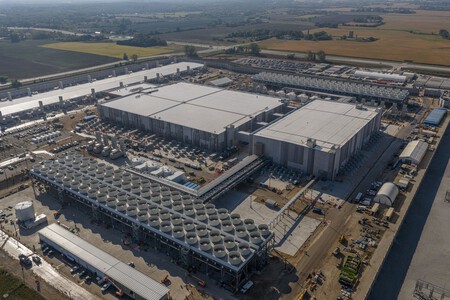
Imagine a complex so extensive that it could be mistaken for an industrial city , where every square meter is designed for artificial intelligence to operate seamlessly. This is the vision behind the new Microsoft campus in Wisconsin (United States), known as Fairwater . According to Microsoft, the project aims to achieve an overwhelming goal: to render ten times more than the fastest supercomputer currently available. This ambition underscores the significance of computational prowess in the AI industry.
This data center is fundamentally different from traditional cloud services that host emails or web pages. Instead, it is specifically designed to train and execute large-scale AI models, similar to those powering applications like ChatGPT and Microsoft’s Co-Pilot. Microsoft has announced an initial investment of $3.3 billion , with the project expected to take shape by early 2026 .
When the Cloud Becomes Concrete, Steel, and Many Chips
Contrary to popular belief, the cloud does not simply float in the air; it is manifested through concrete foundations, metal structures, pipes, and cables that stretch underground for kilometers. Fairwater stands as a prime example of this reality. Microsoft CEO Satya Nadella stated that this campus would be instrumental in meeting the ever-increasing demand for energy and computing capacity . In the race for artificial intelligence dominance, having data centers of such magnitude can offer a critical competitive edge.
The secret to Fairwater’s impressive computational power lies in its organization. Each rack is equipped with 72 Nvidia Blackwell GPUs , interconnected via NVLink and NVSWITCH to enable data sharing at speeds reaching up to 1.8 terabytes per second while accessing 14 terabytes of combined memory. Microsoft has not disclosed the exact number of racks; instead, they simply mention “hundreds of thousands of accelerators.” This combined setup will act as a single supercomputer with the ability to process 865,000 tokens per second , demonstrating an extraordinary scale that will integrate into Microsoft’s Azure Network.
Beyond mere technology, Fairwater captivates with its massive physical dimensions. The facility spans over 100 hectares and includes more than 110,000 square meters of constructed space. The civil engineering efforts behind this project are remarkable:
- 75 kilometers of foundational piles
- 12,000 tons of steel structure
- 193 kilometers of medium voltage electrical wiring
- 117 kilometers of mechanical piping
One of the most significant challenges in any data center is cooling , and for Fairwater, this is even more essential given the high density of chips. According to the Wisconsin Climatology Office, this state experiences a marked thermal amplitude : winter temperatures can drop below 0 °C , while summer temperatures often exceed 25 °C with high humidity. This climate variability necessitates infrastructure that remains effective regardless of weather conditions, unlike in northern Europe, where a consistently cold climate can facilitate cooling naturally.
To tackle these cooling issues, Microsoft has opted for a liquid cooling system in a closed circuit that only requires water during construction and then recycles it without any loss. Over 90% of the cooling capacity will operate through this method and is supported by the second-largest water coolers globally, alongside 172 six-meter-high fans to help dissipate heat. This innovative design ensures that the data center maintains efficiency year-round, even when local weather conditions are less than ideal.
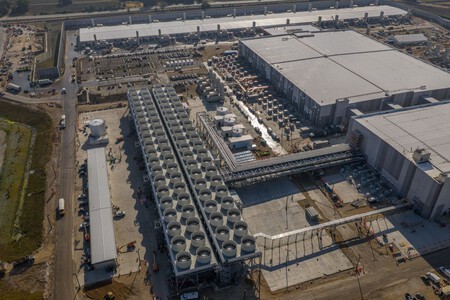
Beyond cooling, Fairwater includes numerous additional elements designed to support massive datasets without encountering bottlenecks. Some notable features include:
- Exabyte-scale storage capacity
- Systems occupying the size of five soccer fields
- More than two million reading/writing operations per second for each cloud storage account
- A dedicated system to accelerate data access and reduce latency, ensuring that GPUs are constantly operational
- Sufficient optical fiber to wrap around the Earth 4.5 times .

While Fairwater remains under construction, many of its ambitious claims still await validation. Microsoft asserts that by its launch in early 2026, it will deliver performance up to ten times greater than the world’s fastest supercomputer, though the benchmark against which this claim is made remains unspecified. The true potential of Fairwater will only reveal itself once it is operational, allowing for an assessment of whether these impressive figures stand up to scrutiny.
Images | Microsoft | Xataka with Gemini 2.5