
In recent months, major US tech companies have tightened their policies regarding office returns, eliminating remote work options and focusing on the accelerated development of AI . However, the Spanish labor market is charting a different course regarding teleworking.
According to the report ‘V Telework Radiography in Spain September 2025, prepared by InfoJobs, although there has been a decrease in telework compared to the records from 2020 to 2022, the practice has remained stable at levels that are double those recorded before 2020 .
Teleworking in Spain. While Silicon Valley headlines are abuzz with news on the end of remote work, Spain’s workforce is adapting differently. Data from InfoJobs indicates that 25% of workers currently engage in some form of remote work or a hybrid format.
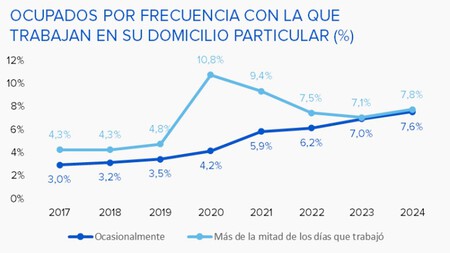
<img alt="Going to the office was going to make employees with better ideas. The problem is that they have to go all the same day" width="375" height="142" src="https://i.blogs.es/4403e2/redmind-studio-7j757-djnew-unsplash/375_142.jpeg"/>The latest data from the Active Population Survey (2024) suggests that 7.8% of the active population worked at least half of their weekly hours from home, while 7.6% indicated they did so occasionally. This equates to approximately 3.2 million people , resulting in a teleworking percentage of 15.4% among total employed individuals. This figure significantly surpasses the 6% recorded in 2019 or the 8.3% just before the pandemic.
Source: InfoJobs
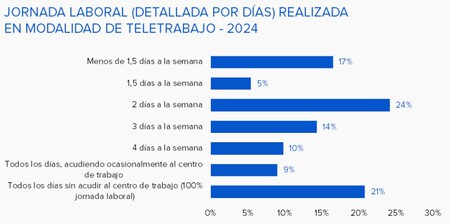
Hybrid work: the balance between flexibility and availability. A key accomplishment in teleworking’s success in Spain lies in its evolution towards hybrid formats , in which face-to-face days alternate with teleworking days. The InfoJobs report reveals that 44% of those teleworking utilize this hybrid model, working one to four days remotely. Specifically, 24% telework two days per week, while 21% maintain a fully remote work setup.
Currently, 46% of companies offer some form of remote work. Within this group, only 11% maintain a 100% remote model, reflecting a decrease from 12% in 2024. Nevertheless, offers for hybrid work have risen, climbing from 33% to 35% within just one year.
Source: InfoJobs
Leading sectors in teleworking. While various sectors have witnessed growth in remote job offers, the commercial and sales sector leads with the highest number of employees working remotely alongside the volume of new vacancies ( 39,184 published offers ). In contrast, sectors like pharmaceuticals (283 vacancies) and graphic design and arts (499 offers) have the fewest remote job opportunities.
Regarding teleworking distribution across sectors, the computer science and telecommunications sector accounts for 68% of remote job offers, followed by legal (58%) and finance (52%) . Approximately seven out of ten professionals in these fields operate under some remote work model. Conversely, sectors that require onsite presence , such as tourism, health care, and trades, report teleworking rates below 1% .
Who and where works remotely. The demand for remote positions is particularly high among profiles like IT analysts , Backend and Frontend developers , ICT consultants , and full-stack engineers , with teleworking options ranging from 75% to 90% in published job offers. Geographically, a notable trend emerges: despite the ability to work remotely, workers remain close to their companies. This is largely attributed to the hybrid work model, which, while reducing commuting, encourages workers to remain in their home regions.
The distribution of remote work is most significant in Madrid (40%) , followed by Catalonia (19%) and Andalusia (11%) , areas recognized for their presence in technology, commerce, and finance.
Image | Unspash (Rodeo Project Management Software)