
The flying car industry is on the brink of transforming urban mobility, but recent mishaps remind us that safety is paramount. A recent incident involving the Xpeng Aero electric vertical takeoff and landing (eVTOL) aircraft has raised significant concerns. During a rehearsal for the Changchun Air Hall in northeast China , two eVTOLs collided in mid-air, resulting in one of the craft igniting upon landing. Social media platforms, particularly Weibo , saw a flurry of images and videos capturing the harrowing moment smoke billowed from the wreckage.
What Happened. As reported by Sina , the accident took place on September 16 at the conclusion of a training exercise. The two craft were attempting a maneuver but collided due to a failure to maintain adequate separation distances. While one aircraft managed to land without incident, the other sustained significant damage and caught fire upon landing. Thankfully, the company confirmed that all personnel onboard escaped unharmed, and emergency responders quickly intervened. A formal investigation is currently underway, but preliminary findings have yet to be released.
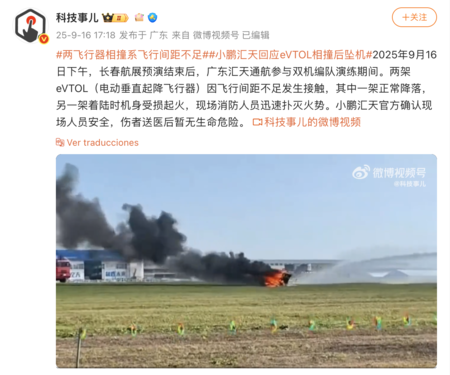
Click to see the original publication in Weibo
The Vehicle and the Concept. Xpeng Aeroht has emerged as a key player in the burgeoning low-altitude economy . The flagship offering from the company is the *(name)* “Land Carrier,” a revolutionary design that integrates a land-and-air vehicle. The ground segment operates as a support base, while the aerial module takes to the skies, employing a unique six-fold arm design that enables vertical takeoff and landing. This innovative design seeks to redefine urban transportation, marrying convenience with aerial capabilities.
Separations and Avoidance. Successful air operations hinge on maintaining clear distances between aircraft. Depending on various factors such as altitude and speed, vertical, horizontal, and temporal intervals are modified, always with safety margins in mind. Xpeng Aeroht has invested heavily in sensors and avoidance algorithms to enhance safety protocols. However, it remains unclear how these systems performed in this specific incident, highlighting the ongoing challenge of ensuring safety in increasingly crowded skies.

The company, according to reports from Sina and Bloomberg , noted that they are currently unable to determine the definitive cause of the collision. Factors such as inadequate separation, altitude discrepancies, operational errors, or even adverse weather conditions—a strong wind reported by witnesses—could have contributed to the accident.
Rapid Growth. In a remarkably short period, Xpeng Aeroht has managed to secure approximately 5,000 pre-orders . This ambitious industrial project includes plans for a factory capable of producing 10,000 flying cars annually , with development commencing in October 2024 . This factory will function as a large-scale assembly line, reinforcing the company’s commitment to innovation. Currently, Xpeng Aeroht is part of the broader Xpeng Motors ecosystem, which recently expanded into Austria . They employ over 1,400 staff , with more than 80% specializing in engineering and development.

Goals and Challenges. The recent accident comes at a critical juncture for Xpeng Aeroht as the company aims for mass production by 2026 . The incident has introduced uncertainty regarding their timeline and intensified concerns regarding the safety of eVTOL technology. While the market exhibits high demand evidenced by thousands of reservations, public trust is vital. Before commercial flights can become a reality, manufacturers must demonstrate that their technologies are trustworthy and reliable.
Images | Weibo | Xpeng Aeroht
In conclusion, the world of flying cars is full of potential, but incidents like these serve as sobering reminders of the challenges ahead. Balancing innovation with safety will be crucial for companies like Xpeng Aeroht as they pave the way for a new era in urban mobility.