
The Rising Interest of Foreigners in Spain’s Housing Market
Spain has long been a favorite destination for tourists, but a noteworthy trend has emerged in recent years: a surging interest among foreign investors in purchasing real estate. As of 2024, this trend was partially fueled by the controversial Golden Visa program, which allowed non-EU citizens to obtain residency permits through substantial investments in Spanish property. While the government announced the termination of this scheme in April 2025, the data from the real estate sector reveals a compelling picture of foreign investment dynamics in Spain.
Foreign Investment Trends
According to data from the College of Registrars, foreign citizens represented approximately 15% of all housing transactions in 2024, equating to almost 93,000 homes bought by non-residents. This mark indicates a 14.6% share of total transactions, close to the historical high of 14.98% achieved the previous year. The increase in foreign purchases reflects not only the allure of the Spanish climate and culture but also an emerging trend focused on investments in coastal and urban areas.
Foreigners and Tourist Hotspots
The impact of foreign investments is especially evident in popular tourist destinations. Areas like the Balearic Islands, Valencian Community, and Canary Islands witnessed remarkable figures, with foreign buyers accounting for about 30% of transactions. In the Balearic Islands, foreigners made up a staggering 32.62%, making it the region with the highest foreign investment density. This trend isn’t just significant in major cities; even smaller towns are seeing a rise in foreign property ownership.
|| Autonomous Community | % Purchase of Foreigners (2024) | Annual Variation (PP) |
|———————-|—————–|—————–|—————-|
| Balearic Islands | 32.62% | +1.12% |
| Valencian Community | 28.92% | -0.34% |
| Canary Islands | 27.23% | -1.31% |
| Murcia Region | 23.63% | -0.21% |
| Catalonia | 16.26% | +0.47% |
| Andalusia | 13.97% | -0.98% |
| Total Spain | 14.6% | -0.38% |
Regional Differences
The varying percentages of foreign purchases indicate that investment dynamics differ across regions. In some areas such as Extremadura, Galicia, and Castilla y León, foreign transactions represent less than 4% of the total. In stark contrast, booming tourist regions continue to see overwhelming foreign interest.
Non-Resident Buyers
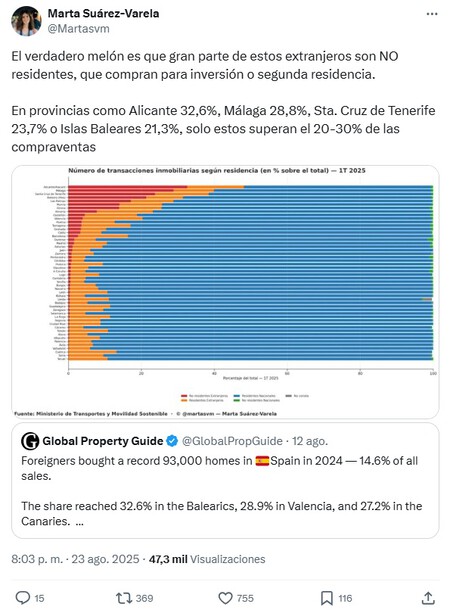
Not only are foreign investors making significant purchases, but a considerable portion of them are non-residents. For instance, in the first quarter of 2025, non-resident buyers accounted for about 32% of transactions in Alicante, exemplifying a notable preference for homes typically sought after as vacation residences.
| Territory | Total Transactions (2024) | Non-Resident Foreigners | Percentage |
|---|---|---|---|
| Alicante | 57,090 | 20,169 | 35.3% |
| Malaga | 37,719 | 10,500 | 27.8% |
| Santa Cruz de Tenerife | 12,445 | 2,728 | 21.9% |
| Balearic Islands | 15,464 | 3,932 | 25.4% |
The Golden Visa’s Influence
The Golden Visa program, initiated in 2013, was designed to attract international investment to Spain’s struggling real estate market. In 2024, 10.8% of foreign purchases exceeded €500,000, the threshold set under the program allowing property buyers to acquire a residency permit. Although this program has since been discontinued, its influence can still be seen in current market activity.
What Are Foreigners Buying?
Data from the College of Registrars indicates that about 7.5% of mortgages signed last year were by foreign individuals, revealing a growing reliance on financing options to acquire homes. The average mortgage amount was approximately €171,200, with British, Germans, and Moroccans leading the charge as the top buyers.
In looking at the types of properties, it’s evident that second-hand homes remain popular among buyers, particularly among less affluent foreign nationals. Meanwhile, new construction is preferred by wealthier individuals, particularly from the Belgian, Polish, and Dutch demographics.
The Future of Foreign Investment in Spanish Real Estate
The Spanish government aims to restrict foreign acquisition of residential properties, mainly to address the challenges faced by local buyers. Authorities argue that withdrawing the Golden Visa will make housing more accessible to residents. However, trends indicate that foreign interest will likely remain robust, bolstered by Spain’s year-round appeal.
Spain’s ability to manage both local housing demands and foreign investment will determine the housing landscape in the years to come. Despite government initiatives aimed at curbing foreign ownership, the value of the Spanish lifestyle continues to attract international buyers.
With its sunny weather, rich cultural heritage, and relatively low property prices compared to other Western European countries, Spain remains an attractive destination for foreign investors. Whether this trend will shift towards more sustainable, locally beneficial practices will only unfold in the coming years.