
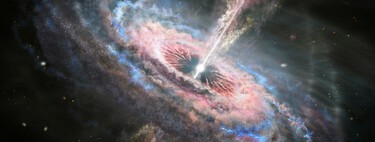
The Anticipated Explosion of a Black Hole: A New Frontier in Cosmology
In the coming decade, the astrophysical community may witness a cataclysmic explosion of a black hole, as detailed in a recent model published by the Physical Review Letters. Observing this powerful event could affirm Stephen Hawking’s most renowned theories while also providing a catalog of previously unknown particles in the universe.
A New Dawn for Astrophysics. Researchers from the University of Massachusetts Amherst have recalibrated the probability of witnessing a dramatic explosion of a black hole by factoring in the existence of primordial black holes that have been lying dormant. Their findings suggest that there is more than a 90% chance we could experience this extraordinary phenomenon within the next decade, contingent upon the initial assumptions of their study.
This exciting conclusion may herald one of the most transformational events in modern cosmology , challenging existing perceptions and enhancing our comprehension of the universe’s structure.
The High Stakes of Observation. Observing a black hole explosion carries significant implications across multiple fronts. It would represent the first direct observation of Hawking radiation , the groundbreaking theory proposed by Hawking in the 1970s, which posited that black holes gradually lose mass by emitting particles, thereby contradicting the notion that they are entirely black.
Moreover, it is predicted that the explosive event will emit a spectrum of fundamental particles, ranging from familiar entities like electrons and quarks to enigmatic components such as dark matter and other particles that remain entirely uncharted.
Finally, this occurrence would provide evidence for the existence of primordial black holes . Contrary to those formed from the collapse of massive stars, primordial black holes are theorized to have formed under the extreme conditions present during the universe’s infancy, less than a second after the Big Bang . Joaquim Iguaz Juan, a co-author of the study, claims, “It would completely revolutionize physics and help us rewrite the history of the universe.”
The Mechanics of Black Hole Explosions. The hypothesis of black holes being able to explode stems from the principles of Hawking radiation . The theory indicates that smaller black holes possess higher temperatures, resulting in accelerated particle emission. This cycle initiates a feedback loop: as a black hole radiates energy, it loses mass and becomes hotter, leading to an exponential increase in radiation until it culminates in a high-energy explosion of gamma rays .
However, past assumptions led physicists to believe the likelihood of observing such occurrences was exceedingly low. Traditional calculations suggested these explosions would occur only once every 100,000 years —a timeframe that rendered witnessing one exceedingly improbable.
The 90% Probability Explained. The research team modified their foundational assumptions, asking: what if primordial black holes are not electrically neutral? They proposed a new theory entailing a force analogous to electromagnetism in a ‘dark sector’ involving a dark photon and a massive dark particle. If a primordial black hole interacts with a slight charge, it radically alters its eventual fate.
This process acts as a regulating mechanism . As the black hole undergoes Hawking radiation , its load-to-mass ratio escalates, significantly boosting its temperature and putting it into a hibernation state lasting billions of years. Eventually, the intense electric field generated near the black hole’s horizon overwhelms it, precipitating the long-awaited explosion.
Why does this enhance our probability of observation? The long hibernation phase enables lighter black holes, which are consequently more prevalent, to persist until now, vastly increasing the potential for local explosions from one every 100,000 years to an astonishing one every 10 years .
Today’s Technological Readiness. Fortunately, we do not need to develop new technologies for detection. Existing gamma-ray observatories such as Hawc in Mexico and Lhaaso in China are already scanning the skies and are adept at identifying the explosive signatures of nearby primordial black holes, even from distances up to 0.3 light-years .
“With our current capabilities, we are well-equipped to observe these explosions; it is crucial that we remain ready,” says Michael Baker, the study’s lead author. Should such an explosion occur, it would mark a historical milestone , offering a first glimpse into the universe’s oldest secrets encapsulated in a magnificent display of light.
In summary, the prospect of witnessing the explosion of a black hole embodies a unique intersection of theoretical physics and observational astronomy, promising to enhance our understanding of the universe in profound ways.