
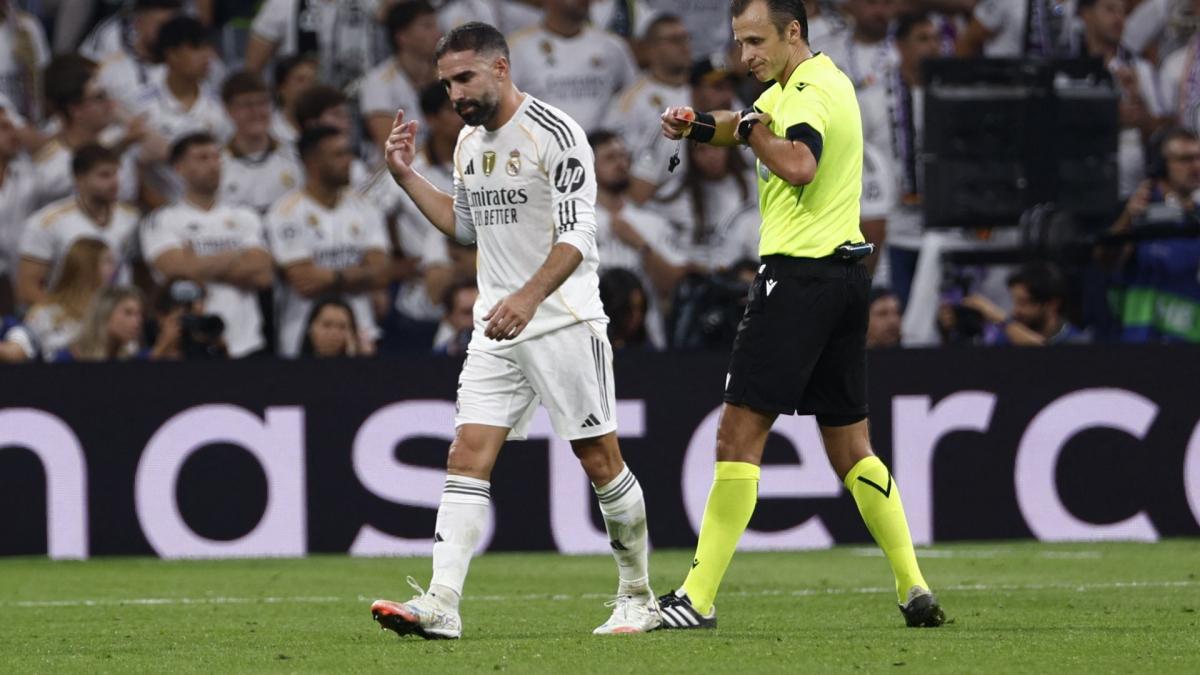
The Controversial Match: Dani Carvajal’s Red Card and Its Impact on Real Madrid
In a dramatic encounter during the ongoing Champions League, Dani Carvajal made headlines for all the wrong reasons. The Spanish international, known for his tenacity and defensive skills, faced an unfortunate ejection from the match against Olympique de Marseille (OM). This incident ignited discussions about player conduct and its implications for Real Madrid’s strategy moving forward.
Carvajal, who is a pivotal figure in conjunction with the team’s robust defense, received a red card in the 72nd minute of the match after a confrontation with Geronimo Rulli, the OM goalkeeper. The altercation occurred just as Real Madrid was preparing to take a corner kick, showcasing how quickly emotions can escalate in high-stakes matches. The timing of the incident was particularly crucial, as Real Madrid had already faced considerable challenges throughout the game, making Carvajal’s dismissal even more consequential.
Xabi Alonso, Real Madrid’s head coach, expressed his frustration over the incident. “The expulsion was avoidable from us, it’s a shame, and we will have to talk about it,” he stated on Movistar, indicating his disappointment not only with Carvajal’s actions but also in the leadership implied by his captaincy. This statement brings forth a crucial conversation about accountability in professional sports and how individual player decisions can rip through a well-laid team strategy.
The implications of Carvajal’s red card extend beyond the match at hand. As one of Real Madrid’s most experienced defenders, his absence places a significant burden on the rest of the squad. The club must now navigate future games without one of their anchors in defense, raising concerns about the team’s ability to maintain their formidable status in the tournament. The remaining players will undoubtedly need to step up their performances in both defensive and offensive plays to compensate for Carvajal’s absence.
Statistics reveal that Real Madrid finished the match with ten men but still managed to secure a victory over OM. This outcome speaks volumes to the resilience and prowess of the Madrid squad. However, questions loom about how long the team can sustain such a situation without incurring more penalties or injuries. Winning under diminished circumstances is one thing, but the relentless pace of the Champions League tests even the most robust teams.
The incident reignites discussions surrounding player conduct, discipline, and the responsibilities that come with leadership roles in sports. Carvajal’s actions – deemed reckless at that moment – raise eyebrows as they beg consideration of the broader implications for team dynamics. It begs the question: can a team maintain its elite status if its leaders do not exhibit the composure required in critical moments?
In discussing these themes, one must examine the psychological pressure athletes face, especially during high-tension matches. The pressure to perform can lead to decisions that are not always reflective of a player’s true character or skill set. Consequently, managing these pressures is imperative not only for Carvajal but for the entire squad. Coaches must foster environments that encourage emotional regulation, allowing players to showcase their skills rather than their frustrations.
Looking ahead, it becomes essential for Real Madrid to develop strategies to handle such future incidents with care. Security measures to diffuse conflicts on the pitch, training sessions focusing on emotional resilience, and cultivating a culture of self-regulation may all contribute to minimizing the risk of recklessness.
On a broader level, football organizations must consider how they approach training protocols concerning player mentality. Are clubs doing enough to equip their athletes with the tools needed to navigate the pressures of international competition? The ripple effect of Carvajal’s actions may just be the catalyst for a much-needed reevaluation of training frameworks across leagues.
In conclusion, the ejection of Dani Carvajal from the match against Olympique de Marseille sends shockwaves through the Real Madrid camp. His actions, while likely prompted by adrenaline and intensity, spotlight the need for greater emotional awareness among players at the highest level of competition. With critical matches on the horizon, all eyes will be on how Real Madrid navigates the storm left in the wake of this incident and whether they can maintain their competitive edge without one of their primary defenders. This situation ultimately serves as a reminder that in football, every action has consequences, both on and off the field.