
Xavier Martinet is a busy man . What is expected when you are the CEO of Hyundai in Europe. But today is different; it is not one of those days when meetings accumulate on the agenda or flights are taken to various countries.
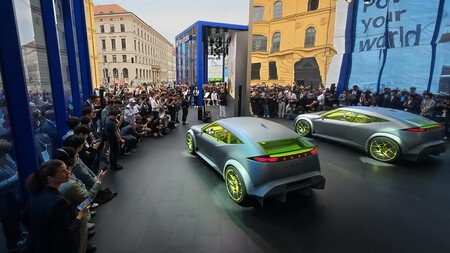
Today, he is busy because Hyundai has decided to unveil its major presentation at the Munich IAA Mobility right on the street. This German city’s Motor Show is now a space that embraces the public. Gone are the days of a closed congress center reserved for press and business, or only accessible through entry fees.
If you’re in Munich during the fair or visiting for tourism, I highly recommend exploring the historic center. Just about 500 meters from Marienplatz , you will delve into the belly of a gigantic Mercedes showcase. Nearby, you’ll find impressive exhibits like the Cupra Tindaya and an American proposal from Lucid, with Porsche and Audi not far away.
Before reaching the end of Ludwigstraße , Hyundai’s stand stands out prominently. The exhibit features four sections; the ends are marked by current models, with an Ioniq 5 on one side and an Ioniq 6 N on the other. Meanwhile, two attention-grabbing design concepts occupy the center stage. On the left is the Hyundai INTEROID , a pumped-up version of the small electric vehicle that looks ready to take on a Rallycross championship .
To the right of Martinet, the Concept Three draws attention, a prototype designed by Eduardo Ramírez, head of the brand’s European design, who will provide insights on it. With Spanish influence at the helm, José Muñoz, the global CEO, also holds significant responsibility for the brand globally.
Both Martinet and Ramírez have engaged with Xataka about their upcoming release.
The Fair Price
“Today we are unveiling the Concept Three . The production version will be launched next year. While we can’t confirm the official name, they can guess it since it bears the Ioniq branding,” says Martinet, who refrains from directly addressing the company’s production model.
For now, the prototype stands as a futuristic concept , and while some may view it merely as a design exercise, Hyundai has taken creative risks with its electric versions. Skeptics might doubt its sharp front end or pixel lighting; yet, the latter is already present across all of the company’s electric vehicles. The former, however, could easily draw attention when placed alongside the stunning Ioniq 6 .
The Hyundai Concept Three appears to be the logical evolution of the Hyundai CR-Z , a car that balances everyday practicality with an appealing aggressive flair. Time will reveal just how bold the company will be with its final design.
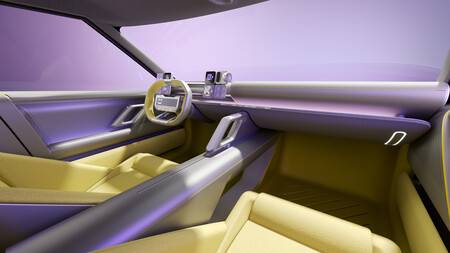
“It is a concept designed for the European, aerodynamic client, prioritizing efficiency but also spacious interiors,” highlights Eduardo Ramírez, the brand’s design head, who, alongside Martinet, is drawing in significant interest today.
For this European customer, price is of utmost importance . “The Hyundai Ioniq starts at €23,000 , and the electric Kona is priced at €37,000 . The production version of the Concept Three will fit perfectly between these two segments. For us, it is crucial to continue positioning ourselves in the heart of the European market, particularly in segments B and C,” Martinet emphasizes.
This raises a fundamental question: Is the public prepared to invest between €20,000 and €30,000 in an electric vehicle, knowing it may introduce complications for long trips?
“Electric vehicles are only one aspect of Hyundai’s strategy. We are also continuously developing hybrid technologies, and maintaining this dual approach is essential,” adds Martinet. “It’s important to illustrate that we can offer a robust selection of electric vehicles across various segments, and showcase that transitioning to electric is achievable.”
This transition has two facets that Hyundai’s CEO is keen to highlight. “While electric vehicles tend to be pricier than their combustion counterparts, they come with advanced technology. However, considering the total cost, it becomes appealing due to lower maintenance expenses, as electricity costs less than gasoline. Electrification is the path to decarbonizing the auto industry,” Martinet explains.
Currently, Hyundai holds a 3.8% market share , stable compared to the previous year but with ample room for growth. “To add value as a brand, we must cultivate the desire for customers to choose our vehicles. Hyundai’s distinctive positioning hinges on its design and technology,” stresses Martinet.
“Let’s not be defensive; let’s take the initiative. We are among the brands best positioned to withstand competition from China,” asserts Hyundai’s CEO for Europe.
“Bold, modern, and surprising”—these are the characteristics Eduardo Ramírez attributes to the brand’s design philosophy, which forms a foundation for the company’s offerings. “For the Ioniq range, we’ve established a distinctive language defined by pixel lighting and an interior treated as a livable space. Each Hyundai vehicle carries identifiable traits, despite their differences in design,” he adds.
Design is undeniably one of the cornerstones supporting the brand, alongside technology. “Take the Ioniq 6 N for instance. We show that sustainability and advanced electrical tech can coexist with a thrilling driving experience, highlighting how electricity and performance can be synonymous,” he emphasizes.
This approach will be crucial in markets like Spain , where price plays a vital role in a vehicle’s success. The influx of Chinese brands in Europe has maximized their focus on affordability and equipage.
“Spain is one of our best markets, and we want to maintain that,” states Martinet, cautioning against the growing threat from Chinese competitors. “However, Hyundai is far more robust than it was 10 or 15 years ago, better equipped to resist and counterattack,” he adds.
According to Martinet, the focus now is on mobilizing customers beyond just price. “A decade ago, European customers bought Hyundai mainly for its affordability. Now, they choose our vehicles because they appreciate the design, innovative technology, and the exceptional service we provide in after-sales. We must continue this trajectory, especially as the Chinese challenge us to improve,” he reflects.
With urgency, Martinet concludes, “Let’s not play defensively; let’s aim for the offensive. Our goal is to score more points than our rivals every time we release a new model or excel in customer service. We are one of the brands most likely to withstand competitive pressures from China.”
Photos | Hyundai
In Xataka | Hyundai Ioniq 9, first impressions: a spacecraft of €80,000 that places Hyundai in another dimension