
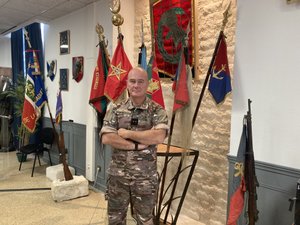
In a complex international context, we recently met with General Stève Carleton, who has assumed command of the 6th light armored brigade (BLB), the largest garrison of the army in France, based in Nîmes .
You have just taken command of the 6th light armored brigade (BLB). What are your aspirations in this position?
My primary mission, and aspiration, is to ensure we are ready for battle . This involves providing the maximum resources, training , and operational preparedness required to respond effectively to any situation, possibly even as soon as this evening. Furthermore, we must also prepare for future conflicts , as the global landscape is rapidly evolving and war has returned to Europe. There are multiple threats looming close to our national borders, and it is our duty to respond to the call of our nation when necessary.
Does this mean that your degree of vigilance is more important today than ten years ago?
Absolutely, yes. There has been a significant shift. Previously, we were engaged in asymmetrical warfare, facing adversaries who were often less well-equipped than us. Since the onset of the Russia-Ukraine conflict in 2022, we’ve entered a different realm of warfare where our opponents may possess resources that are similar to or even superior to ours. They engage in various dimensions of conflict—both tangible and intangible—utilizing military might alongside influence tactics and network manipulation. This makes the nature of conflict more unpredictable, and we may not have the luxury of choosing the place and time of engagement.
“The one who tells you that he was never afraid is a liar. Fear is part of the fight”
How do you manage stress within your teams that can represent war on us?
Anyone who claims they are never afraid is simply lying. Fear is an inherent aspect of battle. However, we manage this fear through rigorous training and instruction. Mastery is essential; as Napoleon once said, “It is a simple art of execution, but extremely complicated.” Soldiers must learn to proficiently use their weapons, maneuver, and coordinate with their units in conjunction with artillery support and other resources. Just as mastering a musical instrument requires hours of practice and theory, mastering warfare requires continuous learning and adaptation to meet evolving threats. For instance, we have recently re-learned how to effectively utilize trenches and obscure our vehicles for protection, especially in light of the increasing threat posed by drones.
In the ongoing Russian-Ukrainian conflict, drone threats account for nearly 60-70% of losses. A striking feature of modern warfare is the shift in military technology ; historically, military advancements often followed civil technological developments, whereas today, it seems to be reversing. For instance, our brigade is innovating by leveraging 3D printing technology to develop our own drones and ammunition, illustrating the importance of innovation within our ranks.
Innovating can be costly. In periods of restricted state budgets, do you believe you have the necessary resources to act?
Currently, there is a law of military progression that is increasing in alignment with our needs. Although the country’s economic situation is critical, France is making considerable efforts to adapt to evolving threats, as the primary duty of any state is to ensure the security of its citizens. The challenge lies in ensuring that our funds are spent effectively.
“Today, war has once again become a way of settlement in international confrontations”
Do you think society is more prepared today to hear about a potential conflict?
Yes, society has evolved in its awareness of threats. Events such as the September 11 attacks in 2001, the 2015 attacks in France , and the Russian invasion of Ukraine have all played a role in heightening public consciousness about the nature of conflict. Today, war is seen as a legitimate means of resolving international disputes, a significant departure from prior perceptions. However, preparing for war is not solely the responsibility of the armed forces. We represent merely the visible portion of a much larger safety framework, which has been bolstered through updates to the national resilience strategy .
Is it still challenging to recruit individuals to augment the military ranks?
We recruit around 28,000 individuals annually, with 16,000 for the Army alone and approximately 250 for Nîmes. Our brigade comprises 7,500 active soldiers and 1,800 reservists. The government’s initiative encouraging two reservists for each active soldier is a noteworthy step, although we still have work to do. Interestingly, conflicts often lead to an increase in recruitment as many individuals express a desire to serve their country. While there was a noticeable slowdown during the post-COVID pandemic years, that trend appears to be reverting.
Do you believe it would be beneficial to restore military service?
I am not in a position to make that decision. It’s important to note that military service hasn’t been abolished, it has merely been suspended. Many countries are contemplating this subject, and a hybrid military model may emerge, combining active personnel with a volunteer and reservist system. It is crucial to re-imagine military service as inclusive, recognizing that both men and women should be considered when addressing recruitment.
What is your stance on the feminization of military ranks?
This topic, in fact, does not pose significant issues. Women who join are welcomed and engaged. While the question of whether there are enough women in the armed forces remains, this varies by unit and role. Some operational functions have a higher female representation than others, highlighting that dynamics in recruitment can differ.
What will be the immediate mission of the 6th BLB?
Since summer, we have been preparing for a key initiative associated with NATO’s Allied Response Force (ARF). This is particularly significant for us as it represents the first time a French brigade has taken on this responsibility within NATO. Our brigade will operate under the command of a division in Marseille . The focus will be on strategic exercises across Europe. It’s essential that we approach this with the utmost diligence and readiness, as the Chief of the Defense Staff has emphasized the importance of being combat-ready, not merely going through the motions.
Who is General Stève Carleton?
General Stève Carleton, born on April 5, 1972, in Grenoble, is a married father of six . He comes from a non-military household and initially considered a career in academia before choosing the army. His military path began within the infantry at the 4th and 2nd foreign regiments. Over the years, he has held various significant positions, including commanding the 2nd foreign infantry regiment and working with the Defense Staff. With extensive operational experience, including deployments to Côte-d’Ivoire , Kosovo , Djibouti , Chad , Afghanistan , and Mali , he has been recognized as an officer of the Legion of Honor and National Order of Merit .
In conclusion, General Stève Carleton’s insights reflect a military landscape that is rapidly changing due to evolving threats and the necessity for increased preparedness. Both the innovation in strategies and inclusivity in recruitment signify a modern approach to military readiness, a crucial focus as contemporary conflicts reshape societal perspectives on warfare. The role of the 6th light armored brigade under his command signifies a pivotal moment in France’s defense strategy as the nation continues to navigate a complex global environment.