
Tourism serves as a vital economic engine for numerous countries around the globe. In nations like Spain, discussing tourism often centers on record-breaking statistics, as it constitutes about 13% of its Gross Domestic Product ( GDP ). The scenario in Spain aligns closely with other tourist powerhouses such as Mexico and Italy , but there are three countries that stand out as significant leaders in the global tourism landscape, which include the United States , China , and Germany .
Experts predict that one of these countries—*China*—is likely to transform its tourism sector within the next decade, positioning itself as a formidable contender on the global stage.
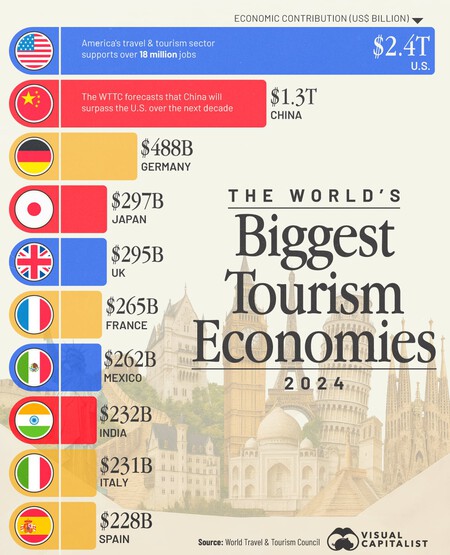
The tourism economy is illustrated comprehensively in a graphic created by Visual Capitalist, showcasing the largest economies linked to tourism for 2024. The data originates from the World Travel & Tourism Council (WTTC) , exploring the financial contributions of tourism to each country’s economy in the past year. The United States holds the title of the leading tourist economy, generating around $2.4 trillion from tourism alone and supporting approximately 18 million jobs in this sector, with New York recognized as the primary destination for travelers.
In second place, China ‘s tourism industry contributed $1.3 trillion to the national economy, representing nearly half of what the United States generates. Trailing behind China is Germany , whose tourism sector accounted for $488 billion . The remaining countries in the top ten contribute significantly less, generally below $300 billion .

China: Heading for Dominance. While still in a strong second position, experts predict that the WTTC reports will reveal a shift in the coming decade, with China potentially surpassing the United States as the leading nation in tourism revenue. The anticipated factors behind this rise include a growing middle class in China and a strong governmental push to expedite the development of its tourism sector.
Projected estimates suggest that tourism could contribute roughly 14% of China’s total GDP, a remarkable figure considering that the current GDP is approximately $19 trillion . If this percentage holds, tourism could inject about $2.6 trillion into the economy.
Europe’s Tourism Landscape. In the broader context of tourism, countries like Mexico , India , and Japan also rely significantly on this sector, but outside of the two leaders, Europe has a significant presence. Germany leads the pack in Europe, closely followed by France , Italy , and Spain leading those in terms of tourism revenue.
Common threads among these countries include rich artistic, cultural, and gastronomic heritages, enhanced by strong transportation networks such as extensive train services and air travel options.

The Economic Dependency on Tourism. The statistics reveal the revenue generated by tourism in relation to overall GDP, but it is also essential to recognize other countries for whom tourism acts as a lifeline. Countries like Malta and Croatia have tourism contributing about 15% of their GDP. Malta, for instance, has a population of approximately 540,000 yet expects nearly 3.5 million tourists in 2024. In August alone, tourist numbers nearly matched the island’s population, which poses both opportunities and challenges for economies heavily reliant on this sector.
This heavy reliance can make such nations vulnerable to global economic fluctuations, leading to potential crises if tourism dips significantly. The complexities of balancing economic growth while ensuring sustainability in tourism makes ongoing dialogue and strategy essential for many of these economies.