
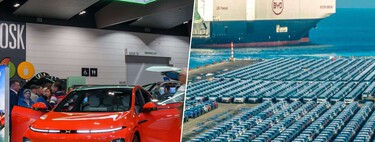
The Chinese automotive industry is on a relentless journey to expand its market presence globally. Recent developments showcase a dramatic shift from focusing on tariffs and restrictions in the U.S. and Europe to a new era of exporting cars in bulk. With Chinese manufacturers now sending ships laden with vehicles to various parts of the world, their sights are set not only on Europe but also on Africa and Latin America .
Strategic Maneuvers. In a bid to streamline operations and bypass financial barriers, Chinese companies are enhancing their dealer networks in Europe while establishing local manufacturing plants. Instead of traditional manufacturing techniques, firms are opting for kits that can be assembled locally. This move is a direct response to tariffs on electric vehicles , prompting companies like BYD to rethink their strategies. With new alternative destinations, they are focusing on regions with fewer commercial barriers and higher growth prospects—namely North Africa and certain Latin American countries.
<img alt="Xpeng's CEO discussing the future of Chinese automotive industry" width="375" height="142" src="https://i.blogs.es/d94d75/xpeng/375_142.jpeg"/>Moroccan Industrial Growth. A prime example is Morocco , which boasts a robust automotive manufacturing industry headed by companies like Renault and Stellantis . The country has strategically positioned itself as a key exporter, with nearly 90% of its production allocated to international markets. Thanks to its geographical location and commercial agreements with various nations, Morocco is now a hotspot for Chinese automotive companies. They are exploring opportunities to set up battery manufacturing plants and other vital components critical for electric vehicles.
This strategy aligns with China’s ongoing quest to control the global supply chain of critical minerals , including cobalt, which holds immense importance in electric vehicle production. The nation’s efforts underscore the significance of these resources in a world rapidly transitioning to sustainable energy.
Unmet Demand in Emerging Markets. The situation in Morocco parallels that of Mexico in its relationship with the United States, serving as an entry point for Chinese vehicles into burgeoning markets. Not surprisingly, countries like Brazil are also emerging as attractive businesses hubs. Chinese automakers are keen on fulfilling demands left by traditional manufacturers, producing complete vehicles tailored for sale in these emerging markets.
Experts anticipate that a rising urban middle class in regions such as South Africa , Algeria , Egypt , and Nigeria will significantly boost sales for Chinese automotive brands. With vehicle ownership still quite low—approximately 40 cars per 1,000 people —the potential for growth is tremendous. Egypt, for instance, is fervently working towards a transition to electric transportation, while South Africa aims to introduce more incentives for electric vehicle production and adoption.
The Competitive Landscape. Interestingly, Japanese automotive brands are prominent players in the African market. According to Masakazu Ohira , head of the Toyota Africa Mobility Department , the annual new car volume in Africa is a mere 1.2 million , whereas the second-hand market is around five million vehicles. Japanese brands often export used cars to Africa, which are then refurbished and sold anew. However, Chinese brands are gradually capturing market share with competitive pricing and robust after-sales support.
Rapid Growth Projections. Brands like Wuling and Great Wall have already started selling their vehicles in countries such as Kenya , where their prices are significantly lower than those of European, North American, and Japanese manufacturers—by 20% to 30% . Consulting firm AlixPartners predicts that the market share of Chinese automotive brands in Africa and the Middle East will skyrocket from 10% in 2024 to an astonishing 34% by 2030 . This growth is facilitated by an already substantial increase in exports; for instance, from January to May 2023 alone, exports to Africa reached 222,000 units , representing a 67% year-on-year increase.
While these projections may seem ambitious, it is crucial to recognize the dual strategy at play. Chinese automakers aim not just to sell vehicles in Africa and Latin America but also to establish production facilities in these regions, paving the way for entry into more established markets in Europe and the United States.
<img alt="BYD's market performance and challenges in electric vehicle sector" width="375" height="142" src="https://i.blogs.es/5e3caa/byd/375_142.jpeg"/>As the automotive market continues to evolve, the relentless drive of Chinese manufacturers to redefine their role on the global stage becomes increasingly evident. Their capacity to adapt to market demands, embrace local opportunities, and leverage strategic partnerships in emerging regions positions them to become formidable contenders in the international automotive landscape.