
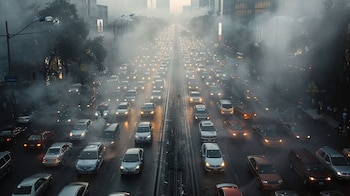
Understanding Air Quality in Mexico City: A Current Overview
The atmospheric monitoring direction of Mexico City recently published its report regarding the city’s air quality. This report covers the capital and the surrounding areas in the State of Mexico, providing crucial information for residents and authorities alike.
Authorities update the air quality status every hour, allowing capital residents to take necessary precautions regarding outdoor activities. Understanding air quality is essential for public health, prompting measures such as the environmental contingency alert, which may include restrictions like the double circulation policy on certain days.
The most recent report from the Atmospheric Monitoring Directorate covers the period from September 5 to 3:00 PM. Currently, the air quality in and around Mexico City is classified as “Bad“, indicating a “High” health risk.
This classification is particularly important for individuals engaged in outdoor activities, especially those who belong to vulnerable groups such as children, the elderly, and people with pre-existing respiratory issues.
Moreover, the sun’s intensity is another concern. The ultraviolet (UV) index has been noted at a level 4, indicating that protective measures are necessary when spending time outside.
In response, local authorities recommend the following precautions: if you have sensitive skin, consider wearing a hat, UV-filtering sunglasses, and applying sunscreen with an SPF of 30 or higher to protect yourself from potential harm.

According to the Atmospheric Monitoring Directorate, 16 stations across Mexico City measure air quality. Results reveal varying conditions across different areas:
- Tlalpan (AJM): Good
- Benito Juárez (Bju): Bad
- Azcapotzalco (CAM): Good
- Coyoacán (CCA): Acceptable
- CUAJIMALPA (CUA): No data or maintenance
- Gustavo A. Madero (GAM): Acceptable
- Cuauhtémoc (HGM): Bad
- Iztacalco (IZT): Bad
- Venustiano Carranza (Mer): Bad
- Miguel Hidalgo (MGH): Bad
- Álvaro Obregón (PED): Acceptable
- CUAJIMALPA (SFE): No data or maintenance
- Iztapalapa (SAC): No data or maintenance
- Tláhuac (Tah): Good
- Coyoacán (Uax): Acceptable
- Iztapalapa (UIZ): No data or maintenance
Meanwhile, in the neighboring State of Mexico, the 13 monitoring stations reported varying levels of air quality:
- Atizapán (ATI): Bad
- Chalco (Cho): Good
- Cuautitlán Izcalli (CUT): Bad
- Naucalpan (FAC): Bad
- Nezahualcóyotl (FAR): Acceptable
- Ecatepec (lla): Good
- Annex of Tlalnepantla (LPR): Acceptable
- Nezahualcóyotl (Nez): Bad
- Ecatepec (SAG): Good
- Tlalnepantla (TLA): Bad
- Tultitlán (TLI): Bad
- Coacalco (vif): Bad
- Ecatepec (XAL): Acceptable
It’s crucial to note that some municipalities have multiple atmospheric monitoring stations, leading to repeated mentions on the list. The air quality metrics differentiate into five levels:
- Good (Green): Minimum health risk; outdoor activities are suitable for all.
- Acceptable (Yellow): Sensitive groups may experience respiratory symptoms; others can continue outdoor activities.
- Bad (Orange): Increased risk for vulnerable populations; everyone must exercise caution.
- Very Bad (Red): Serious health risks for sensitive individuals; avoid outdoor activities.
- Extremely Bad (Purple): Severe respiratory issues probable; high risk of premature death for sensitive individuals.
Vulnerable groups include children, the elderly, and those engaged in outdoor work or exertion. Public awareness and timely information can significantly mitigate health risks linked to poor air quality. Staying informed and taking the right precautions is vital for the health and safety of all residents in Mexico City and its surroundings.
For ongoing updates, be sure to follow trusted local news sources or official government pages.