
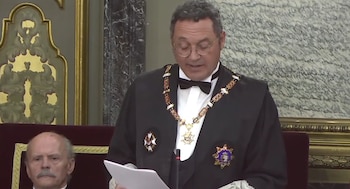
“I am fully aware of the unique circumstances of my intervention as a result of my procedural situation.” With these words, the State Attorney General, Álvaro García Ortiz , commenced his address, emphasizing his “full consciousness” of his individual status amidst an ongoing investigation. He attended the opening of the judicial year out of a deep-seated belief in justice and the integrity of the institutions that uphold it, asserting that it is also a matter of embracing the concept of truth itself.
The atmosphere in the Plenary Hall of the Supreme Court was charged with tension, as most associations of judges and prosecutors, alongside half of the CGPJ (General Council of the Judiciary), had expressed their strong objections to him attending this event due to his prosecution for a crime of revelation of secrets , which has led to a forthcoming trial.
“I respect all opinions that may be expressed on the matter, and will address it only briefly in this speech: if I am here as State Attorney, it is because I believe in justice and the institutions that uphold it. I have unwavering faith in the rule of law , in the independence of the judiciary , and in the principles of legality and impartiality . And, of course, I believe in truth ,” he stated, under the watchful eyes of judges and prosecutors—some of whom are expected to preside over his future trial.
Context of Álvaro García Ortiz’s Address
Álvaro García Ortiz’s speech comes at a crucial time for the Spanish judicial system, plagued by questions of integrity and justice. His statements reflect both a personal and systemic struggle, especially given that the judicial landscape is marked by controversies that challenge the credibility of its officials. The Supreme Court, amidst its challenges, represents the pinnacle of legal authority in Spain, further compounding the significance of García Ortiz’s role as the State Attorney General.
His presence at this event is not just about legal obligations; it also embodies larger themes within the Spanish society, where public confidence in the justice system has wavered. With his reputation hanging in the balance, García Ortiz has positioned himself at the center of a precarious balancing act, trying to affirm his commitment to justice while facing ongoing scrutiny.
The Repercussions of Legal Proceedings
The ongoing legal battle against him raises questions not just about his future, but about the wider implications for the judiciary and political landscape in Spain. His flexibility in navigating these issues appears both admirable and fraught with risk. The judicial independence he touts may be tested in court, where ethical and legal boundaries will be examined closely.
There is a palpable anxiety felt by many within legal circles, grappling with the notion that justice itself could be perceived as compromised. The major associations of judges and prosecutors that have expressed dissent towards his attendance symbolize a broader concern regarding accountability and the perception of fairness within the judicial process.
Public Perception and Trust in Justice
Public trust in the legal system is necessary for a functional democracy. The actions and choices of prominent figures like Álvaro García Ortiz come under intense public scrutiny, serving as a barometer for the state of justice in Spain. His claims about commitment and belief in the institutions that uphold justice must translate into tangible actions that reassure a skeptical public. Careful navigation through this labyrinth of complexities is essential, not just for his personal reputation but for the credibility of the judiciary as a whole.
Ultimately, the challenge lies in restoring faith in the system, something that García Ortiz must prioritize even as he prepares for potential legal consequences. The balance between his belief and the impending scrutiny embodies a crucial juncture for Spain’s legal system, where the outcome may redefine perceptions of justice , integrity, and public trust.
In reflecting on these themes, it becomes clear that the situation of Álvarez García Ortiz serves as a pivotal reminder of the complexities involved in modern governance and the weight of public expectation.