
The Future of Alcohol-Free Drinking: Can We Get the Buzz Without the Booze?
Imagine it’s a Friday evening . You’re on a terrace at the bustling heart of the city with friends, basking in the last rays of summer. As you contemplate ordering a couple of cold beers, the lurking thought of a potential hangover and the ensuing wreckage of your weekend makes you hesitate. Instead, you opt for a ‘non-alcoholic’ beer. But what if there existed an alcohol-free IPA or spirit that could evoke the desired euphoria and loosen you up, all without a single drop of alcohol, hangover, or risk of becoming dependent?
This fascinating prospect is the brainchild of a British laboratory.
What’s prompting this innovation? The alcohol industry is currently experiencing a challenging period marked by a significant decrease in demand in pivotal markets. A generational shift in drinking habits has emerged, with an increasing number of consumers gravitating towards non-alcoholic drinks . Some visionaries want to go a step further, aiming to achieve what they call the ‘holy grail’ of beverages: concocting liquors and beers devoid of alcohol but still reproducing the sensations associated with intoxication.
<img alt="The alcohol crisis impact on drinking habits in Spain" width="375" height="142" src="https://i.blogs.es/352b8c/53939908376_d59844b47e_k/375_142.jpeg"/>Who’s spearheading this movement? At the forefront is David Nutt , a renowned neuroscientist with deep expertise in studying how drugs impact the brain, addiction, and mental health. Nutt acknowledges that while drinking offers social benefits, he strives for a healthier and safer enjoyment of alcoholic experiences—one that avoids the risks associated with addiction or liver damage.
To achieve this goal, several years ago, Nutt co-founded GABA LABS , a company aiming to “provide social drinkers with the benefits of alcohol without the drawbacks.” The team is working on a patented compound called ALCARELLE , which is tasteless and colorless and is designed to facilitate relaxation and social interaction.
The primary function of ALCARELLE is to enhance the effects of gamma-aminobutyric acid (GABA), a neurotransmitter that signals the brain to relax. GABA LABS aspires to produce a creation that surpasses traditional alcohol in pleasure without the usual pitfalls, offering effects akin to intoxicating drinks without the dreaded hangover.
What stage are they at? According to GABA LABS’ official statements, they predict that ALCARELLE and related products will hit the market in the United States by 2028, though Nutt is hopeful for a 2027 launch .
Since its inception nearly a decade ago, GABA LABS has tirelessly sought molecules effective at interacting with GABA receptors in the brain. This painstaking process has led them to narrow down their options to three promising candidates, which they hope to further test and refine.
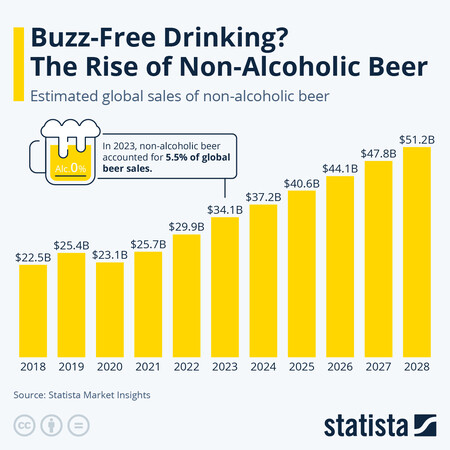
<span>Statista graph.</span>Have they launched any products yet? Yes. To showcase GABA’s findings, we needn’t wait long. In 2021, the company introduced a small batch of its drink in the UK, followed by a launch in the US. Named I Feel , this drink does not incorporate the target ALCARELLE yet; instead, it utilizes natural components to serve as a precursor to Nutt’s future aspirations. The creators market it as a viable alternative for individuals seeking a functional drink to enhance their social interactions without the drawbacks of alcohol.
What about ‘GABYR’, the alcohol-free beer? Recently, EFE reported on the launch of GABYR , a non-alcoholic beer that purportedly induces a disinhibiting effect similar to traditional alcohol. It boasts the same relaxation and sociability characteristics typically sought in alcoholic beverages but with a significantly reduced negative impact.
The GABA LABS team is also exploring the production of alcohol-free spirits such as whiskey and wine.
Why does this matter? The implications are substantial. This revolutionary approach offers the promise of mitigating the social and health-related risks of alcohol consumption while maintaining the pleasurable experiences often sought in social settings. Nutt emphasizes the need for a non-addictive alternative, avoiding the all-too-familiar hangover. Interestingly, effects could be felt within approximately 20 minutes of consumption.
Such advancements raise intriguing questions across various fields: How will they be regulated? What impact will this have on driving? And how will authorities monitor its use compared to traditional alcohol? Concerns about potential side effects such as drowsiness or memory loss also fuel skepticism.
Is there more to come? Absolutely. Beyond Nutt’s innovative vision, the lucrative alcohol industry is undergoing notable transformations. Consumer trends show that Generation Z demonstrates a declining interest in alcohol, with movements such as Dry January gaining popularity. As non-alcoholic options gain traction, projections indicate that global sales of these beverages may surpass $50 billion by 2028.
For context, the Statista portal reports that the non-alcoholic drink market in the US generates around $900 million annually. Should Nutt successfully achieve his ambitious goals, he could become a major player in this booming industry.
In conclusion, the pursuit of alcohol-free alternatives that still deliver the enjoyable effects of traditional drinks represents not just a potential market shift but also a reflection of changing social attitudes towards alcohol consumption. With increasing awareness of the health risks associated with drinking, the innovations by GABA LABS could not only reshape our drinking culture but also provide safer, more enjoyable alternatives for social drinking.