

The satellite images of China’s military parade rehearsals, held in Changjing near Beijing, reveal a grand spectacle planned for September 3, commemorating the 80th anniversary of the end of the war against Japan. This display not only serves as a homage to historical events but also stands as a bold demonstration of naval and strategic capabilities aimed primarily at intimidating the United States and its allies.
China is taking this seriously, with ambitions that extend beyond mere military might.
A missile showcase to deter. Analysts have noted that satellite imagery highlights a range of advanced military technologies , including mobile missile systems, sophisticated drones, and a comprehensive array of anti-ship missiles . Key models such as the stealthy YJ-18C, characterized by subsonic speeds, the ramjet-propelled and supersonic YJ-15, and the hypersonic-capable YJ-21, are pivotal in ensuring that the U.S. Navy cannot easily dominate the Western Pacific waters. Among them, the YJ-19 , which can reportedly travel at speeds exceeding Mach 10, further underscores China’s commitment to outclassing potential adversaries.
This extensive missile deployment focuses not only on countering the naval capabilities of Taiwan but also directs its strategy against the U.S. forces in the region. The underlying message is one of deterrence and the projection of power.
Unmanned platforms. In addition to these formidable missiles, the military parade will showcase unmanned aerial vehicles (UAVs) such as the GJ-11 combat drone and the versatile GJ-2. These drones signify a shift towards incorporating automated technology in military operations, which could change the landscape of naval warfare significantly.
Remarkably, a large submarine drone, reminiscent of Russia’s Poseidon systems, has also been observed. Its purpose remains speculative, but it potentially serves long-range ocean surveillance or even offensive missions. Whether these drones are nuclear-capable remains uncertain, yet their mere presence indicates China’s expanding arsenal of unconventional maritime strategies .
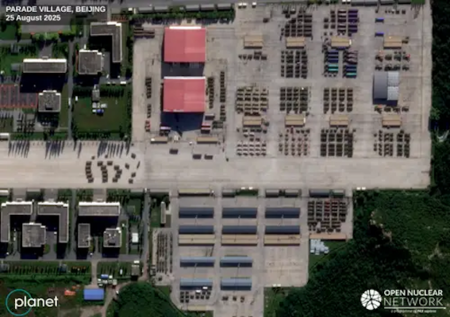
The image of the parade preparation site taken on August 25, showcasing a variety of military vehicles.
ICBM capabilities and scope. The exhibition will also feature intercontinental ballistic missiles like the Dongfeng-41 , which carries a range of up to 15,000 kilometers and can deliver multiple nuclear warheads. China’s advanced capabilities extend to land-attack cruise missiles like the DF-100, designed for achieving targets at supersonic speeds. These developments suggest a growing capacity to engage targets well beyond the Asia-Pacific region, potentially extending to the U.S. mainland.
The sea as an instrument of ascent. An extensive report by BBC reveals that in just two decades, China has ascended to dominate the global naval industry, absorbing over 60% of global ship orders and producing at an unparalleled rate— 200 times faster than the United States. With a fleet consisting of 234 military ships , surpassing the U.S. Navy’s 219 ships , China’s naval capabilities continue to expand, even if the technological edge still resides with the U.S. in areas like aircraft carriers and advanced submarines.
This dominance is mirrored in China’s vast network of bustling ports, which play a crucial role in its economic landscape and geopolitical ambitions, particularly in the South China Sea.
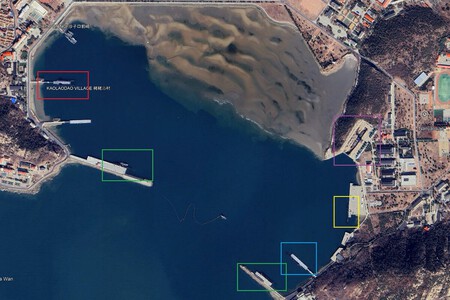
A newly established Chinese naval base housing six nuclear submarines.
Dual shipyards and fusion. China’s maritime growth is notably enhanced by the fusion of civil and military shipyards . Key facilities like Dalian and Guangzhou aim to produce military ships at a rate that outpaces traditional naval powers. This Military-Civil Model , championed by Xi Jinping, ultimately enhances China’s capacity for rapid asset multiplication in scenarios of prolonged conflict.
Extended bases. The qualitative leap in China’s naval operations is evident in the expansion of critical bases, such as Yulin in Hainan, which now features five new docks for Jin-class nuclear submarines, further solidifying China’s strategic posture in the region.
Recent trials indicate the integration of submarine drones capable of allowing long-range surveillance and covert maritime operations. Though many technologies remain experimental, the investment rates suggest a deliberate aim to catch up with Western maritime advancements.
The historical memory. Moreover, China’s naval endeavors are steeped in political symbolism . Xi Jinping frequently ties the nation’s militarization to historical grievances from 1840 to 1949, thus framing its resurgence as a corrective to past humiliations. Military parades showcasing hypersonic capabilities serve to communicate a powerful message of national pride and resilience.

The Taiwan factor and tensions. With this expanded naval strategy, a pressing question arises regarding how China intends to use its growing might. Despite assertions of a non-aggressive stance towards Taiwan, the rhetoric around unification coupled with military readiness casts a shadow over its intentions. The U.S., legally obligated to support Taipei, perceives potential conflict as a risk that could escalate into a broader regional confrontation.
As the Chinese Navy exercises beyond its traditional maritime boundaries, including trials near Japan and circumnavigation exercises in Australia, the Pentagon is tasked with revitalizing its naval capabilities after years of neglect. The future balance of power in the Pacific hinges on who can deploy more vessels rapidly and effectively—a race that will ultimately define naval control in this pivotal region.
Image | Google (Via Alexluck), Planetlabs/Nuclear Network Open
In Xataka | China has realized something: missiles are not necessary if you are able to monitor 1,500 km away
In Xataka | China has finally shown its “murderer of aircraft carriers” for the Pacific: a hypersonic weapon that is hidden in cities.