
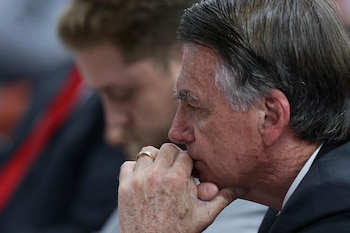
The Supreme Court of Brazil is gearing up for a high-profile trial involving former President Jair Bolsonaro, who served from 2019 to 2023. This trial comes after Bolsonaro’s alleged attempted coup following the 2022 elections, which saw current President Luiz Inacio Lula da Silva emerge victorious. Scheduled to begin this Tuesday, Bolsonaro will not be attending the trial in person, opting instead to remain at home due to ongoing health issues, particularly hiccup crises that have, at times, necessitated vomiting.
Since August 4, Bolsonaro has been under house arrest, wearing an electronic anklet as part of the restrictions placed upon him. His medical conditions include hypertension, reflux, and bronchoaspiration, leading his lawyers to advise against his attendance in court, as reported by the Brazilian newspaper Folha .
Bolsonaro, alongside seven co-defendants, stands accused of being a central figure in the coup plot that could lead to sentences of over 40 years in prison. The Brazilian judiciary is treating this case with utmost seriousness, given its implications for the nation’s democratic processes and the rule of law.
Adding tension to the situation, on Saturday, Supreme Court Justice Alexandre de Moraes instructed the Criminal Police of the Federal District of Brasília to establish a monitoring system around Bolsonaro’s residence. This surveillance aims to document any visits to his home, particularly to guard against any potential attempts at fleeing. Indeed, a police report has raised concerns that the former president might climb over a wall separating his property from a nearby area, where he could access transportation to the U.S. Embassy for a potential asylum request.
Further underlining his intentions, documents found on Bolsonaro’s mobile phone have revealed that he has sought political asylum from Javier Milei , the recently elected president of Argentina. Considering the polarized political landscape in Brazil and the implications of a former leader allegedly seeking refuge abroad, this revelation has stirred significant public interest.
In preparation for Bolsonaro’s trial, Brazilian authorities have tightened security measures at the Supreme Court . An increased presence of the Federal District Military Police will remain in place through September 12, the projected date for the trial’s conclusion. Additionally, an integrated intelligence unit is operational at the Ministry of Public Security in the Federal District, indicating the government’s commitment to safeguarding the judicial process.
The accusations against Bolsonaro have triggered a broader discourse about democracy and security in Brazil. Observers note that the trial does not merely revolve around an individual but resonates with deeper concerns about the integrity of Brazil’s political framework post-2022 elections. The implications of this trial could extend beyond Bolsonaro himself, impacting political strategies, voter sentiments, and the overall perception of power in Brazilian politics.
Public sentiment remains divided; some continue to view Bolsonaro as a champion of their right-wing values, while others see him as a symbol of extreme partisanship that threatens Brazil’s democracy. This polarization underscores the lasting effects of his presidency and actions during and after the election.
As the opening of the trial approaches, various political factions in Brazil are waiting to see how the judiciary handles this unprecedented situation. The outcome may set a precedent for future conduct by politicians, the accountability of public officials, and what it means to challenge electoral outcomes based on personal beliefs rather than democratic principles.
The Supreme Court’s handling of this case will likely play a vital role in shaping Brazil’s future political landscape, one that is characterized by ongoing dialogue about democratic ideals, accountability, and the future of governance in a nation that has experienced significant political upheaval in recent years.