
The Underrated Role of Food Processing in Human Evolution
The food processing revolution was as transformative as the hunt in the evolutionary history of humanity. For years, the dominant narrative has overshadowed this critical aspect, but a recent analysis in Smithsonian Magazine, originally published in Sapiens, emphasizes how the daily work of women and children in food transformation was not only vital for survival but also instrumental in promoting essential biological changes in the human species.
This perspective, spearheaded by anthropologist Karen L. Kramer, challenges the traditional belief that places hunting on a pedestal as the primary engine of human evolution. Instead, it foregrounds cooperation and the division of labor in hunter-gatherer societies.
Food processing involves a set of techniques that make natural resources safe and edible. This adaptation was crucial for human survival for millions of years. Beyond simple collection, the transformation of roots, seeds, and fruits expanded the diet and helped populations endure periods of scarcity. Traditionally led by women and children, this task proved essential for overcoming challenges and enabling the expansion of human territories.
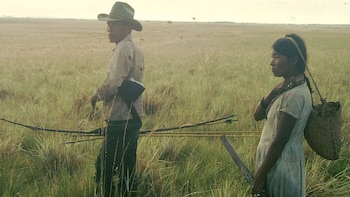
A striking example can be found among the Pumé people of Venezuela, a hunter-gatherer community residing in the plains of southern Venezuela. During the rainy season, when savannas flood and hunting decreases, women and children become the pillars of subsistence. Remarkably, while men often return empty-handed after long days of hunting and fishing, women and children proficiently collect underground tubers that form the dietary foundation during these challenging times.
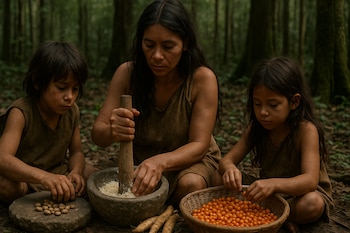
Even young girls, as young as five, participate in this vital task, collecting roots the size of a thumb. Once back at camp, the labor continues: they peel, cut, and soak the tubers to remove bitterness before roasting and sharing. According to Smithsonian Magazine, during these adverse conditions, women and children contribute an astonishing 85% of the calories consumed by their community.
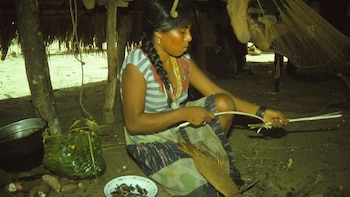
Food processing involves more than merely making it edible; it also requires the neutralization of toxins and improvement of conservation. Fundamental foods in the human diet, like yucca (cassava), contain toxic compounds that require specific techniques for safe consumption. Other products such as certain legumes and grains can become dangerous without processes like soaking, cooking, and fermentation. The knowledge of transformation and storage is essential for survival, particularly in regions where seasonal production necessitates the creation of food reserves. Without this knowledge, vast areas of the planet would remain inhabitable.
The food transformation beckons introspection into human anatomy over time. Significant evolutionary trends—like the reduction of teeth and jaws and shorter digestive tracts—reflect a shift toward softer, processed foods that were prepared outside of the body. This change not only freed up space in the skull for brain expansion but also reduced the time spent chewing. Today, humans invest just 5% of their day in chewing, roughly 35 minutes, a stark contrast to other primates like chimpanzees, who spend nearly half their day chewing.

Cooperation and division of labor have been foundational in hunter-gatherer societies. The daily life of the Pumé illustrates how survival relies on collaboration among individuals of various ages and genders. No one person could manage all tasks like collecting food, obtaining water, processing firewood, crafting tools, and caring for children. Therefore, the organization of labor and specialization of tasks is essential.
Among the Pumé, women devote nearly two hours daily to making tools and utensils for collecting and processing. Involving children early fosters community participation. This objective is similarly present among the !Kung people of the Kalahari, where women spend roughly an hour each day on tool-making and repairs.
The principles of collaboration and processing are also prevalent in North America, where indigenous communities developed collective techniques to produce pemmican, an energy-dense food made from rendered fat, dried meat, and berries. The preparation and processing of berries demanded swift collaboration among many women to harvest before they were consumed by wildlife. Pemmican became essential for enduring harsh winters and enabled communities to settle in extreme climates.

Despite ethnographic and archaeological evidence, traditional narratives about human evolution often prioritize hunting as the engine of cooperation, food distribution, and social organization. Yet, as Smithsonian Magazine highlights, even meat must be processed to be effectively utilized.
This emphasis on hunting tends to obscure the crucial contributions of women and children in food transformation—a task far from secondary, as it was decisive for the success and expansion of humankind. The diverse array of foods we enjoy today stems from a silent revolution: the daily rituals of processing, cooking, and transforming food, predominantly led by women, allowing humanity to thrive in various environments across the globe.