
Do you remember what was the first web browser you used? Whatever your answer, the truth is that, essentially, the way we use them has not changed much since the days of Netscape Navigator.
Yes, over the years, browsers have undergone significant transformations. Initially, they displayed flat pages, almost like a digital newspaper, while today they support websites rich with photos and videos. They were the pioneers who introduced tabs , forever changing how we organize our online activities.
Security has also improved dramatically with the introduction of HTTPS. Responsive design has ensured that the web can be accessed seamlessly on mobile devices without sacrificing usability. Despite these changes, the fundamental actions have remained the same: enter , write , click , and navigate pages ourselves.
Advances There Were Many, But the Interaction Remained the Same
This dynamic, however, may be on the brink of transformation. There are compelling reasons to believe that it will change soon. The technology sector is increasingly focused on automation , with AI agents taking over much of the heavy lifting.
These systems are designed to:
- Plan and break down complex tasks into manageable steps.
- Choose the most effective tools to accomplish objectives.
- Remember context to provide tailored solutions for users.
Imagine having agents capable of managing various tasks from start to finish. From organizing a trip with hotel and flight reservations to managing your weekly grocery shopping, creating spreadsheets, or handling specialized software. You would simply need to provide them with instructions and, where necessary, give permission to conduct actions on your behalf, confirming purchases or resolving issues only when absolutely required.
This would lead to a more straightforward interaction model: communicating via text in a chat window or, even better, using voice commands. Say goodbye to wrestling with menus, forms, and the traditional interfaces that accompany most web applications.
We are already witnessing early steps in this direction. Perplexity has introduced a feature called “Comet,” an AI browser that executes tasks on the user’s behalf . OpenAI introduced “Operator,” which was later integrated into the ChatGPT agent mode along with its own browser.

Claude’s Extension for Chrome in Action
Meanwhile, Anthropic has entered the race with an extension of Claude capable of controlling Chrome, while Google is developing Project Astra—a broader agentic system that extends beyond just the browser and can operate directly on Android devices.
For now, many of these innovations are still in the experimental phase with limited deployment. However, with the rapid advancements in technology, it’s likely we will soon see these become standard ways to interact with the web.
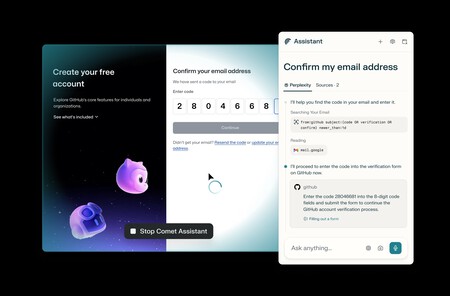
Comet, the Agentic Browser of Perplexity
Just remember how we operated before November 30, 2022, when ChatGPT did not exist. Barely two years and eight months later , technology has dramatically altered the landscape.
Of course, not everything comes without challenges. One of the most significant hurdles with browser agents is security . Concerns abound regarding potential miscommunication leading to reservations or purchases that users did not intend to make. Additionally, there’s the looming risk of these agents becoming victims of cybercriminals , who are now exploring methods to manipulate them just as they once attempted to deceive us through phishing and scams.
Malicious instructions are a clear and present danger. If humans can be misled, agents could also be tricked into executing actions against their users, such as revealing passwords or extracting sensitive information.
The question remains: Are we entering the era of artificial intelligence agents in browsers ? Would you consider using them?
Images | Xataka with Gemini 2.5
In Xataka | If you don’t know why your Instagram has been filled with orcs and sharks, the answer is simple: a false video generated with AI.