
SpaceX’s Starship Successfully Completes Tenth Test Flight
After three failed attempts and several catastrophic explosions, SpaceX can finally breathe a sigh of relief. Starship’s tenth test flight has met all the objectives that had eluded them thus far, marking a significant milestone in the company’s ambitious plans for space exploration .
Short but significant. The largest rocket in the world not only launched and reached outer space but also successfully displayed its first payload—an engine refitted for vacuum conditions—and managed a controlled descent into the Indian Ocean . This mission provided proof that SpaceX’s designs are evolving and improving.
Starship’s successful tenth flight illustrates that SpaceX’s iterative design process continues to work. While the vision of a fully reusable spacecraft for colonizing Mars remains a distant goal, Starship is ready to begin launching Starlink satellites into orbit.
A promising start. At the scheduled launch time, the 33 Raptor engines of the Super Heavy booster roared to life, lifting the towering structure, which stands over 120 meters tall. Although one engine faced a malfunction halfway through the launch, the mission continued without a hitch, showcasing the system’s redundancy.
As the massive Starship rocket consumed its 4,900 tons of propellant , it successfully passed through the most critical phase of aerodynamic stress, igniting the motors of the upper stage before separation. The Super Heavy then initiated its return, not aiming for a soft landing but rather executing a series of challenging maneuvers.
A skyscraper floating in the air. Booster 16 navigated through the skies, successfully shifting its trajectory. After gliding for a few minutes using its aerodynamic fins, it intentionally deactivated one of its central engines to test if a backup engine could take over its flight.
The most remarkable moment came shortly thereafter when the 70-meter rocket managed to hover above the ocean using two engines, before powering down and making a controlled descent. As one commentator noted, “A 20-story building in the air has just floated.” This pivotal achievement highlights SpaceX’s advancing capability to control the Super Heavy booster during capture procedures with the launch tower, although re-entry remains a challenging ordeal.
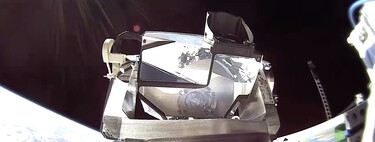
The cargo dispenser in action. While the Super Heavy fulfilled its phase of the mission, the Starship 37 continued its journey toward space. Once in a suborbital trajectory, it was time for two of the most anticipated tests of the day to commence.
The first test involved the opening of the cargo bay and the deployment of the first payload. Using a mechanism that resembled a candy dispenser , the ship successfully ejected eight Starlink satellite simulators, one by one. This test is crucial, as Starship’s future as a heavy-lift vehicle hinges on its capability to deploy payloads effectively.
Everything ready to launch Starlink satellites. SpaceX plans to launch as many as 60 Starlink V3 satellites in future missions, contributing an impressive 60 Tbps of capacity to the constellation with each launch. This figure is more than 20 times greater than what a Falcon 9 can carry with the current V2 Mini.
The rocket has showcased its capability to reach orbit, deploy payloads (albeit with a minute required for each satellite), and perform complex maneuvers. Flight 10 successfully demonstrated the refinement of a Raptor engine in a vacuum. This ability is essential for controlled landings or conducting translunar injections, particularly for upcoming NASA Artemis missions .
Surviving hell to tell. After an hour into the flight, Starship began its re-entry into Earth’s atmosphere at hypersonic speeds —a phase where previous missions had faltered. However, this flight exhibited a robustness reminiscent of early launches.
Cameras onboard showed visible damage—some areas of burned ailerons and a slight explosion in the engine bay—yet Starship maintained aerodynamic control throughout the descent. Guided by its spoilers, the vessel successfully navigated through the heat and plasma during re-entry.
The flight culminated with a gentle and controlled landing in the Indian Ocean. While the ship showed signs of substantial wear and tear, the mere fact that it completed re-entry and landing successfully, after three consecutive failures, is a monumental victory for SpaceX. This achievement provides definitive proof that Starship is prepared to initiate Starlink launches.
Image | SpaceX
With each flight, SpaceX moves closer to realizing its lofty ambitions in space exploration, paving the way for a future where advanced technology meets insatiable human curiosity. The successful mission of Starship’s tenth flight is a testament to persistence and engineering ingenuity, underscoring the transformative potential of reusable rocket technology.