
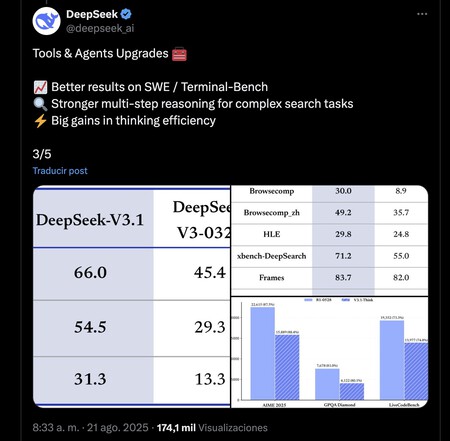
The Deepseek R1 made headlines at the beginning of the year, shaking the foundations of the AI industry and commanding attention as a pivotal model. The anticipation surrounding its performance, particularly in areas like reasoning and programming , was palpable. However, the journey since then has been anything but static. The recent launch of the Deepseek V3.1 has unveiled a series of developments that merit deeper examination, particularly concerning its performance and the market landscape .
Deepseek V3.1 Announces Its Arrival
This week, the startup announced the launch of Deepseek V3.1 , an upgraded version that combines the speed of Deepseek V3 with the advanced reasoning capabilities of Deepseek R1 . This hybrid model has generated excitement due to its significantly enhanced performance based on published benchmarks. Early users have noted that it outperforms its predecessors in certain domains, particularly programming and mathematical tests. However, there are caveats.
Visible but Non-Dramatic Improvements
According to the model card released on Hugging Face, Deepseek V3.1 shows a modest improvement in reasoning modes compared to its powerful predecessor, Deepseek R1. Despite the advances, users have commented on its limited capabilities . While it excels in programming tasks, it struggles in following user prompts and instructions, a critical drawback for many users. Furthermore, it only offers limited multimodal support , primarily focusing on text interactions and lacking functionalities for voice, image, or video inputs. This narrow approach could hinder its appeal in an increasingly diverse AI marketplace.
A Chinese Model for Chinese Chips
Another noteworthy aspect of Deepseek V3.1 is its strategic design centered around reducing reliance on foreign chips. By utilizing FP8 precision , the model is optimized for upcoming Chinese processors, aligning seamlessly with the Chinese government’s priorities . The commitment to local development mirrors a broader trend in which domestic technologies are increasingly favored over foreign alternatives. This move could establish Deepseek as a more integral player in the national tech landscape, catering to a growing demand for self-sufficiency in artificial intelligence.

Deepseek R1: What Lies Ahead?
The fate of the now-quiet Deepseek R1 creates speculation. The startup has seemingly removed references to it as a “deep thought” model, raising concerns about the potential arrival of a Deepseek R2 . This silence has left analysts pondering whether the anticipated successor will fulfill the lofty expectations set earlier this year.
Facing User Losses
As speculation about R2 lingers, Deepseek is encountering an immediate challenge— losing users . Reports suggest a notable decline in its market share within the open-source AI models on the PPIO cloud platform. After reaching a staggering 99% in the first quarter, that figure plummeted to 80% in the subsequent quarter, a clear indication that the company is feeling the heat from local competitors.
Fierce Competition on the Rise
This decline in relevance is largely attributed to fierce competition from local models, particularly Alibaba’s Qwen family, alongside newer entrants like Kimi-K2-Instruct developed by Mooscota AI. The influx of options is compelling users to explore alternatives, challenging Deepseek to regain its footing in a rapidly evolving market.
Delays and Strategic Decisions
Rumors abound that the development of a potential Deepseek R2 is stalling. Reports from the Financial Times indicate that challenges in training the model with Huawei chips have pushed the team to employ Nvidia technology instead. This dual reliance on different architectures for training and inference has sparked debate over Deepseek’s operational strategy. While this may provide a short-term solution, it raises questions about long-term sustainability.
A Chinese Philosophy on AI Development
While the Western market expects rapid advancements, the Chinese approach often emphasizes long-term strategies . Chinese companies typically maintain a lower profile while strategizing behind the scenes, marked by a philosophy of gradual improvement. Deepseek exemplifies this trend, suggesting that despite current challenges, they are likely working meticulously to ensure their position remains prominent within the AI landscape .
In summary, as the AI race intensifies, particularly with local models gaining traction, all eyes will be on Deepseek. The launch of V3.1, while improving certain metrics, raises questions regarding user experience, market competition, and the strategic direction to take to remain a leader in this dynamic field. All these factors will play a crucial role as the world of artificial intelligence continues to evolve.