

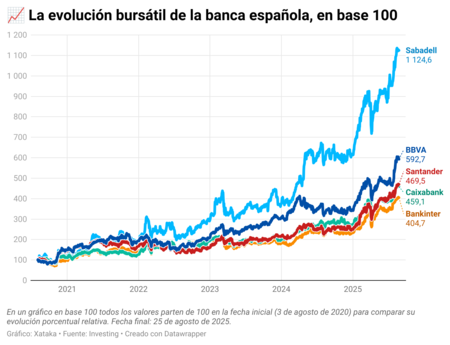
Sabadell has risen by more than 1,000% in the stock market over the last five years, with Santander following closely at 370% , Caixabank at 359% , and BBVA with an impressive 492% increase. In stark contrast, tech giants like Apple, which has frequently held the title of the most valuable company in the world, only managed to grow by 82% in the same timeframe. Microsoft saw a 120% increase, while Nvidia made headlines with a remarkable growth of 1,267% . These stats paint a surprising picture of the resilience and rebound of traditional Spanish banks in a landscape dominated by rapidly growing tech firms.
Why is this Important
The transformation of these Spanish banks is noteworthy as they have shifted from being perceived as the “ugly ducklings” of the stock market to becoming shining stars amid one of the most significant reevaluations in the European market. This change challenges the narrative that paints banking as a mature industry characterized by narrow profit margins, lacking excitement and innovation.
The transformation within these banks has been both silent and profound . While the world of investment seems preoccupied with the hype surrounding AI and technology, Spanish banks have quietly multiplied their market capitalization , showcasing resilience without causing too much commotion. Investors who traditionally overlooked Spanish banks may need to reevaluate their views on this sector.#p#
The Context
Looking back at the past five years, it’s essential to acknowledge that this upward movement coincides with the market lows experienced during the pandemic . In March 2020, the IBEX 35 index plunged to about 6,100 points . However, even when considering benchmarks prior to COVID-19, the growth figures remain exceptional.
A significant catalyst for this transformation has been the rise in interest rates. After enduring over a decade of negative rates, which squeezed profit margins, the European Central Bank (ECB) ‘s policy shift has rejuvenated traditional banking profitability. This shift allows banks to capture low-rate deposits and then lend at significantly higher rates, creating a more favorable economic environment for these institutions.
Comparative Growth
To further contextualize these figures, the S&P 500 has risen 84% during the same period, while the Nasdaq has increased by 116% . Additionally, gold has appreciated by 78% , showcasing that traditional banking is not the only sector entering a phase of growth, but its resilience through various economic landscapes is particularly noteworthy.
Public Perception
Despite the impressive stock market explosion of these banks, the reality is that this shift has largely flown under the radar of the general public . The prevailing narrative continues to paint traditional banking as a dull sector, weighed down by competitive pressures from fintech companies and neobanks. This misunderstanding could lead investors to miss out on lucrative opportunities within the traditional banking sector.
Clearly, traditional Spanish banks have generated financial returns that surpass many celebrated tech firms . As investors begin to recognize this potential, the narrative around banking could shift dramatically, opening the doors to new investment opportunities.
The Future Outlook
Looking ahead, the key question remains: Will this rally continue, or have we already reached the peak? With interest rates stabilizing and signs of some deceleration in the Spanish economy, there is a possibility that the best growth may have already transpired. However, what this banking sector has illustrated is that in a world increasingly captivated by technology, boring sectors can still yield impressive profits . The traditional banking landscape, once deemed unexciting, is proving its worth in the evolving economic climate.
In summary, the remarkable growth trajectory of Spanish banks over the past five years has reshaped perceptions about an industry often viewed as staid and uninspiring. The impressive performance results not only challenge existing narratives but also invite scrutiny into the possibilities that lie ahead for traditional banking, encouraging a fresh perspective from both investors and the general public.