
In life, Pedro de Luna y Gotor (1328-1423), also known as Benedict XIII or Pope Luna, was a figure both fascinating and controversial. Though his life was undoubtedly captivating, what he probably never imagined was that his skull would eventually feature in a tale worthy of a Dan Brown thriller , embroiling two villages in a heated legal battle over who rightfully deserves to host this relic.
Now, this story has taken a new turn.
What happened? Surprisingly, Pope Luna, a figure who passed away over 600 years ago, has become central to a contentious legal dispute between two Aragonese towns: Illueca and Sabiñán. Located just a 15-minute drive apart, these two communities, together with a population under 3,500, are at odds over the claim to Pope Luna’s remains.
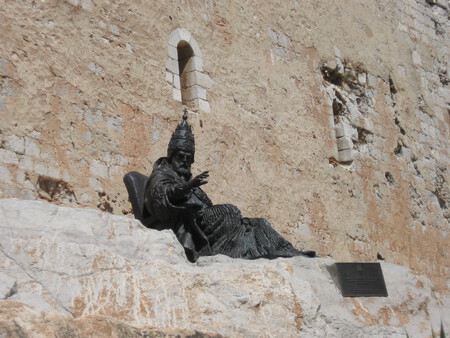
Why is it news? The conflict regarding Pope Luna’s skull, the only remnant of his body, is not a new development. Both towns have been fighting for years to establish their claim to host the skull. This conflict led, as recently as 2023, to a ruling from the Superior Court of Justice of Aragon, which sided with Sabiñán.
In a surprising twist, Illueca’s City Council is not willing to concede defeat; they have hired a lawyer to reopen legal proceedings. They plan to file a new claim, expected to come about in September, in hopes of reclaiming possession of the skull.
What are their arguments? The previous ruling of the Aragonese court stated that the relic belongs to Sabiñán. Illueca, however, is shifting its focus from ownership to the original intentions of the “antipapa.” Their lawyer, Jorge Español, stated, “We are not asking the judge to determine who owns the skull but rather who can honor the wishes of Pope Luna’s descendants.” This isn’t the first time Español has appeared in legal disputes regarding heritage. He gained recognition for defending Sijena against the Generalitat.
Where does this dispute originate? To understand the roots of this ongoing conflict, one must delve into the peculiar history surrounding Pope Luna’s remains. Upon his death in 1423 in Peñíscola, his nephew retrieved the body and transported it to the Castle Palace of Illueca, where it remained until the early 18th century, when it was desecrated.
Between 1701 and 1707, during the War of Succession, French troops disturbed his grave, ultimately resulting in the loss of all but his skull . This skull fragment was later moved to the Palace of Argillo in Sabiñán, where it rested unbothered for centuries until the early 21st century.
What transpired? In April 2000, the skull was stolen from its wooden urn in a chapel by two young looters who demanded a ransom of one million pesetas from the mayor of Illueca. The subsequent news of the heist captured global attention, though it didn’t last long. Months later, police recovered the skull, which underwent extensive testing, including carbon dating, to confirm its authenticity as Pope Luna’s remains.
After a long process and even a detour to Florida, the relic was eventually returned to the Provincial Museum of Zaragoza in 2021. It was reclassified as a Cultural Asset of Interest (BIC) and was carefully placed in the Chapel of Santa Ana at the Church of San Pedro Apóstol.
What is the current status? The status of the skull is determined by varying perspectives. A few years ago, a court confirmed that the skull rightfully belongs to Sabiñán. This ruling is based on the fact that the skull was gifted to the town by the Olazábal-Bordiu family. For Sabiñán, this has affirmed their claim, given that it was where the skull rested for centuries.
However, Illueca holds a different view. Its community argues that the historical context points back to the 15th century when the Aragon crown authorized the transfer of Pope Luna’s body to Illueca, as requested by his nephew. They believe this decision reflects the desires of the Pope’s relatives.
Why does it matter? The significance of Pope Luna’s skull lies not only in its cultural heritage status but also in the story it encapsulates. Pedro de Luna, or Benedict XIII, remains an intriguing figure from the end of the Middle Ages. He was elected pope in 1394 during the Great Schism of the West . Although he faced numerous pressures, he remained steadfast in defending his legitimacy. His legacy is reflected in the modern phrase, “stay in its 13,” a nod to him as Benedict XIII.
Images | Erik Cleves Kristensen (Flickr), Sabiñán City Council (Robert Gillon), and Mia & Steve Mestdagh (Flickr)
This ongoing saga of the skull of Pope Luna reveals much about the intricate interplay of history, identity, and cultural significance, leaving us with an unresolved narrative tangled in the legacies of two neighboring towns.