
The Current State of Global Nuclear Arsenal: A Dangerous Countdown
In January 2007, the Doomsday Clock stood at five minutes to midnight, symbolizing humanity’s precarious proximity to nuclear devastation. Fast forward to January 2025, and the clock now ticks at a grim 89 seconds to midnight— a stark indicator of our volatile nuclear landscape. This clock serves as a sobering reminder of the precarious balance we maintain between civilization and potential annihilation. The 2025 data are among the direst in the 78-year history of this alarming measure.
Despite ongoing efforts, both the United States and Russia continue to be the dominant nuclear powers, boasting the largest stockpiles of atomic weapons. While each country has made strides to dismantle nuclear arms, the situation remains complicated as nations like China are rapidly advancing their capabilities. Meanwhile, India is also working aggressively to establish itself as a formidable nuclear force.
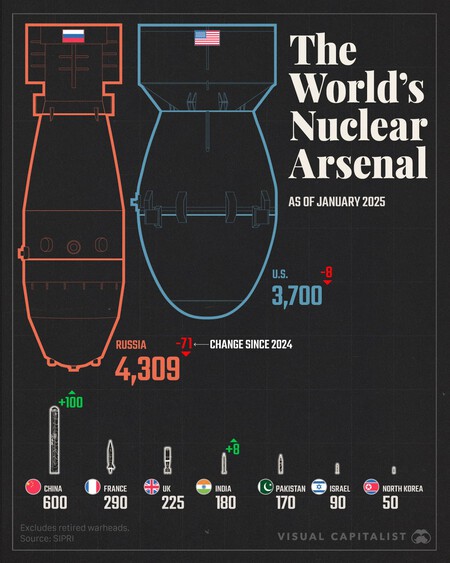
To visually portray the disturbing state of the world nuclear arsenal in 2025, a revealing graph from the Stockholm International Peace Research Institute (SIPRI) highlights these disparities.
Current Nuclear Arsenal: A Detailed Breakdown
The graph effectively encapsulates the status of the nuclear arsenal as of January 2025. Historically, the United States and Russia have dominated the nuclear landscape, particularly during the Cold War. However, recent estimates reveal that both nations are gradually reducing their nuclear stockpiles. Over the last few months, the United States reportedly reduced its arsenal by eight warheads, while Russia has retired an impressive 71.
European nations such as France and the United Kingdom remain steadfast in maintaining their nuclear arsenals, alongside Pakistan, Israel, and a somewhat opaque North Korea, which is estimated to possess around 50 warheads.
Notably, while the US and Russia maintain a significant lead in overall numbers, China has made alarming advancements in its nuclear capabilities, reflecting its intent to become a robust nuclear power.
The Rise of China and India
Recent reports from SIPRI have unveiled that China’s nuclear arsenal has been expanding at an alarming rate. Estimates suggest that by 2024, China could possess around 600 warheads, marking a 20% increase in just a few short months. This rapid growth serves to strengthen China’s position against the US and its allies.
Beyond just a numerical increase, China’s investment extends into modern military technology, showcasing advancements such as electromagnetic catapults on new warships, next-generation weaponry, and state-of-the-art fighter jets.
India, on the other hand, has been investing significantly in its own nuclear capabilities, although it currently has less than 30 warheads deployed. Surprisingly, the United States and Russia each have nearly 2,000 deployed warheads, while countries like France have nearly all of theirs on alert. Despite India being behind the curve in terms of deployment, its recent investments indicate a serious commitment to developing a credible deterrent.
Moreover, North Korea has also made headlines recently. It has added eight warheads to its stockpile, totaling an estimated 180 warheads amidst escalating tensions in the Indo-Pacific region.
The Evolving Landscape of Nuclear Politics
The current global nuclear situation is undeniably complex. Events such as Russia’s invasion of Ukraine have rekindled fears of a potential nuclear conflict. Similarly, recent escalations between Israel and its regional adversaries have raised alarms. In response, China has been promoting defensive pacts concerning its nuclear arsenal, even as treaties like START III, which places restrictions on the total number of strategic nuclear weapons, are set to expire soon.
Furthermore, France’s recent announcement to develop a new generation of nuclear warheads highlights the shifting dynamics of nuclear deterrence among Western powers. These developments reflect the underlying tensions and the arms race that defines today’s geopolitical landscape.
The world stands at a precarious juncture in its nuclear history. As nations tread the fine line between security and destruction , the clock continues to tick ominously toward midnight. As confirmed by recent findings, we may witness shifts in global power dynamics that redefine nuclear capabilities in the years to come, ultimately shaping the future of international relations and global security.