
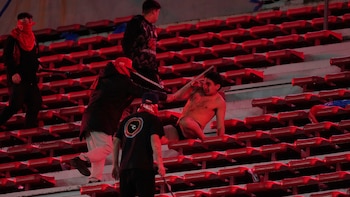
Violence Erupts at Libertadores de América Stadium
After the violent events that unfolded at the Libertadores de América Stadium during the clash between Independiente and Universidad de Chile in the Copa Sudamericana, significant consequences are evident. The Minister of Security of the Province of Buenos Aires has announced the immediate closure of the stadium, which means that Independiente will be unable to play their home game against Platense this Sunday as part of the Clausura Tournament.
Crucial Decisions Following Violence
In a statement on Radio 10, Buenos Aires Security Minister Javier Alonso confirmed, “I understand that the prosecutor has already requested the closure of the stadium because there are also arterial liver stains in the gallery. There will be expertise conducted. Independiente will not play Sunday in their stadium.” The decision has led to a flurry of actions as the team searches for an alternative venue for their match scheduled at 20:30.
Reports indicate that the violence, which includes a premeditated attack by Chilean fans on Independiente supporters, led to the suspension of the match just two minutes into play. Minister Alonso highlighted police inaction during a nearly two-hour window, criticizing their failure to act as aggression escalated against the fans from the Pavoni Alta tribune.
Accountability and Conmebol’s Role
Alonso pointedly directed blame at Conmebol, illustrating that police were repeatedly urging for the suspension of the match. He stated, “Three times the police and the coordinator from Conmebol were urged to suspend the party and did not want to suspend it. If we had halted the game at the end of the first half, and people had exited the gallery, nothing would have happened.” The delay in intervention only exacerbated the violent atmosphere.
The minister further emphasized, “The police do not enter; they do not handle internal security at Conmebol matches. In six games organized by Conmebol this week, we had the same police and device managers, and everything proceeded without incident.” He insisted, “Conmebol does not want the police inside the stadium,” raising serious questions about the safety protocols in place for such events.
Implications for Safety Protocols
A crucial point made by Alonso is that the event was considered a “private event,” placing the onus on the organizers to maintain order. The failure to heed police advice regarding crowd control could have led to a more tragic outcome. “Had they suspended the first half… we have 20 injured; the tragedy could have been much worse,” he added.
He pointed out that previous games had been successful, with no incidents, reinforcing the assertion that the handling of this match was flawed. “What we never did is allow visiting fans above the premises, in a tribune that has no physical barrier, and that also did not have private security,” Alonso explained.
The Aftermath: Arrests and Investigations
The aftermath of the events saw the arrest of Chilean fans involved in the fray. However, all detained individuals have since been released. “In the case of the Chinese fans who were arrested, the accusations were related to the damage to the stadium and minor injuries due to what was thrown from below,” Alonso stated.
Moving forward, he highlighted the need for accountability. “They will have to follow the judicial case back in Chile while the investigation continues into what transpired.” This harsh reality underscores the growing concern about the safety and security of sports events, placing immense pressure on organizing bodies.
Reflections on Future Matches
As the dust settles on the unfortunate events at the Libertadores de América Stadium, questions loom large over the future of similar high-stakes matches. What measures will be taken to ensure that safety protocols are prioritized to protect fans and maintain order? The events serve as a crucial wake-up call for all involved in organizing sporting events, urging them to implement effective strategies that prioritize the well-being of fans above everything else.
The closure of the stadium and the subsequent investigations signal a critical need for reassessing the roles of security personnel and the responsibilities of organizing bodies like Conmebol. When safety becomes compromised, it is essential to ensure that such incidents do not happen again in the future.
Vigorous discussions, evaluations, and changes in policies must follow to foster an environment that honors both competition and safety, reminding everyone that the spirit of sport should unite, not divide, its fans.