

On August 21 , Colombia experienced devastating terrorist attacks in Amalfi (Antioquia) and Cali (Valle del Cauca), resulting in the tragic loss of 18 lives . These heinous acts sparked outrage from the Colombian Liberal Party , who urgently called for a reassessment of the current security strategies employed by President Gustavo Petro .
In the Amalfi attack , criminal factions targeted a national police helicopter, leading to the deaths of 12 police officers . In a related incident in Cali , six individuals were killed following a bomb cylinder assault on the Marco Fidel Suárez airbase . These violent episodes have intensified concerns regarding the state’s capability to ensure citizen safety, igniting a national discourse on security policy effectiveness.
The Liberal Party issued a formal statement condemning the attacks and expressing solidarity with the victims’ families and the public force. They labeled these incidents as “acts of barbarism” and identified them as targeted assaults against both national institutions and the tranquility of Colombian citizens.
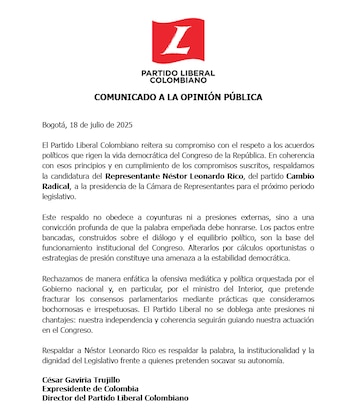
In their criticism, the Liberal Party insisted that the government’s comprehensive security policy has inadvertently facilitated the empowerment of criminal organizations across Colombia. They urged President Petro to take immediate action toward prevailing criminality and to institute a clear, democratic security policy that would restore public trust in governance and rekindle hope among citizens.
The Liberal Party stated, “This costly lesson cannot continue to be paid with the blood of innocent soldiers, police officers, and civilians. ” They underscored the urgent need to adopt a transparent and coherent security policy to reassure the public and foster faith in democracy.
In response, President Petro defended his administration’s approach to security via his social media platforms. He called for a comparison of current crime statistics with those of past decades. He emphasized a focus on homicide rates, referencing the terms of former presidents like César Gaviria (1990-1994) , indicating that 351 days remain in his administration, thus positing a refreshing glimpse at progress made.
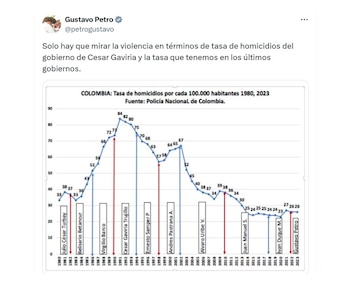
Accompanying his response, Petro shared a graphic illustrating the trend of homicide rates in Colombia from 1980 to 2023 . He stated, “you merely need to assess violence through the homicide rate during César Gaviria’s government and the rate that characterizes the last few governments.” His stance suggests that the current administration has taken steps forward, despite enduring challenges.
Data indicates that Colombia reached a staggering peak of homicides in 1992 , coinciding with Gaviria’s presidency , recording 84 homicides per 100,000 inhabitants . Since that tumultuous period, though disruptions occurred, there has been a steady decline, culminating in 26 homicides per 100,000 amidst Petro’s current administration. Furthermore, while 2002 marked a shift with Álvaro Uribe , homicide rates continued to drop throughout subsequent administrations, illustrating a hopeful trajectory.
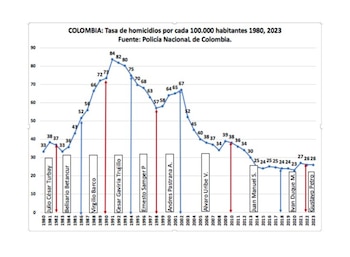
The graphic shared also depicted homicide rates under leaders such as Julio César Turbay (1978-1982) , Belisario Betancur (1982-1986) , Virgilio Barco (1986-1990) , Ernesto Samper (1994-1998) , and Andrés Pastrana (1998-2002) . While historical data illustrates a long-term decline in homicide rates, ongoing concerns about insecurity linger among citizens.
Ultimately, despite the persistent challenges presented by illegal armed groups and public demands for enhanced security, Petro reiterated his commitment to a total peace policy . Facing the criticisms head-on, he stressed the importance of advancing strategies aimed at fostering both national security and reconciliation.