
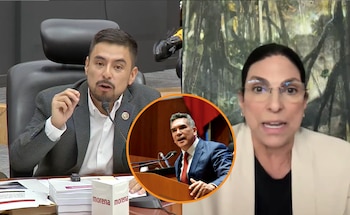
This Thursday, August 21, 2025, the National Electoral Institute (INE) conducted an extraordinary session involving political parties. The session covered seven points, one of which was proposed by the National Regeneration Movement Party (Morena). This point aimed to initiate an informal procedure regarding the financial resources managed by the Institutional Revolutionary Party (PRI) in the state of Campeche.
Deputy Guillermo Rafael Santiago Rodríguez, representing Morena before the Institute, opened the discussion with strong declarations. He stressed that “this is not an occurrence; it is a decision rooted in the Constitution and law which mandates the INE to oversee the origin, amount, destination, and application of political party resources .” His statement underscored the importance of accountability and transparency in political financing.
Santiago Rodríguez pointed towards serious allegations against the PRI under the leadership of Alejandro Alito ‘Moreno Cárdenas, asserting that there are credible public indications of “illicit diversion, simulations, and enrichment” that have favored the party, which he claims contribute to illegal financing . The Deputy’s accusations hinge upon documented evidence that paints a troubling picture of the PRI’s financial dealings.
In his address, Santiago Rodríguez referenced the Campeche Prosecutor’s Office, which has been investigating Alito Moreno for alleged peculation amounting to 83.5 million pesos . He shared specifics about the investigative folder reportedly containing claims about simulated payments exceeding 27 million pesos , irregular contracts of nearly 24 million pesos , unsupported expenditures exceeding 14 million pesos , and inflated bids costing more than 18 million pesos . These revelations point to a worrying pattern of financial misconduct that could undermine public trust in political institutions.
Moreover, Santiago Rodríguez reiterated that during Alito Moreno’s tenure as governor of Campeche, substantial complaints have emerged surrounding the diversion of resources potentially linked to other criminal activities, such as illicit enrichment, money laundering, and tax fraud . He characterized the accusations against Moreno as indicative of “a systematic pattern” of corruption that needs thorough examination.
He didn’t hold back in his critique of Alito Moreno, branding him as a “criminal, malechor, transgressor, criminal.” His claims are supported by numerous journalistic investigations and documented evidence that has led to five separate folders generated by the Prosecutor’s Office. Santiago Rodríguez displayed media covers that have followed up on the allegations against the former governor, aiming to substantiatethe argument that there is a profound issue at stake.
The session concluded with calls for greater scrutiny of political financial management. As allegations stack against Alito Moreno and the PRI, public interest grows in ensuring that political leaders adhere to standards of transparency. In an era where accountability is demanded more than ever, the role of institutions like the INE becomes pivotal in curbing potential malpractices.
With growing concerns about the integrity of political financing, the actions of both the INE and political parties like Morena will be under close watch. The implications of these discussions stretch far beyond Campeche, as the broader political landscape of Mexico continues to grapple with issues around corruption, accountability, and public trust. The narrative that emerges from this session could have long-term effects on how political parties operate in the future, emphasizing the need for rigorous oversight mechanisms to maintain democratic integrity.