
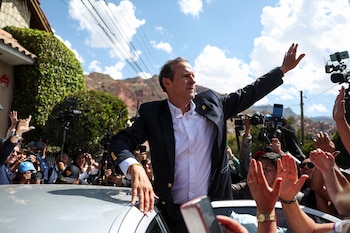
Jorge Fernando “Tuto” Quiroga Ramírez has re-entered Bolivia’s political arena by securing a spot on the ballot for the upcoming elections on October 19. With an impressive 26.8% of the votes in the first round, Quiroga, the representative for the alliance Freedom and Democracy (Free), will compete against Senator Rodrigo Paz Pereira , who emerged as the frontrunner with 32.2% of the votes.
The former conservative president, who held office between 2001 and 2002 following Hugo Banzer’s resignation, claims that his agenda this time focuses on a “radical change” that emphasizes fiscal discipline , commercial openness , and modernization of the State . Quiroga expressed these intentions clearly during a recent interview with CNN, stating, “I am a man of freedom, of free trade.” His plan entails significant cuts to public spending and the pursuit of international agreements to reinvigorate the economy. After the preliminary results were released, he addressed supporters, proclaiming that “a long night of two decades ended,” referring to the end of the Socialism (MAS) movement’s dominance in the country.
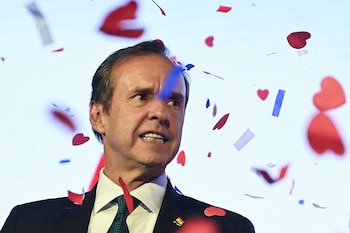
Jorge Quiroga was born in Cochabamba in 1960 , where he studied Industrial Engineering at the University of Texas . After obtaining his Master’s in Business Administration, he began his career at IBM but returned to Bolivia in 1988 to engage in local politics, aligning with the Nationalist Democratic Action (DNA) party founded by Banzer.
His political ascent was rapid. Quiroga was appointed Undersecretary in the Ministry of Planning in 1989 and rose to the position of Minister of Finance by 1992 under President Jaime Paz Zamora , father of his current opponent. In 1997, he became the youngest vice president in Bolivian history at just 37 years old. Following Banzer’s resignation in 2001, Quiroga assumed the presidency. He characterized his leadership, stating, “I assume the presidency in unprecedented and dramatic circumstances.”
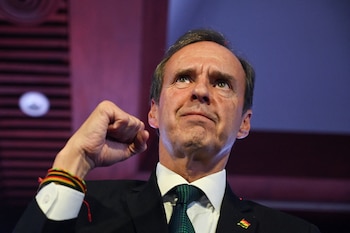
His presidency was marked by efforts to stabilize public accounts amid crisis conditions, famously launching the “Tuto Plan,” an emergency program for job creation. He also sought the eradication of coca crops, aligning with Banzer’s policies. However, due to the brief tenure of his time in office, he struggled to implement substantial structural reforms, although he became a significant figure in Bolivian right-wing politics.
Following his presidency, Quiroga attempted to run for office again in 2005, achieving 28% of the vote despite being bested by Evo Morales, who garnered 53%. He faced significant challenges in subsequent attempts in 2014 and 2020, including a withdrawal from the latter due to lack of support.
Quiroga has been a staunch critic of Morales and the MAS, supporting the Revocatory referendum of 2008 and condemning what he sees as the regime’s authoritarian nature. He even faced legal challenges in 2009 for denouncing corruption in a state bank, a conviction that was later annulled, though it was reopened recently as the electoral campaign intensifies.

On the international stage, Quiroga has been a vocal opponent of the dictatorships in Venezuela, Cuba, and Nicaragua . He actively engages in liberal forums alongside former Latin American leaders and has built alliances with Venezuelan opposition figures like María Corina Machado . Following Bolivia’s political turmoil in 2019, he served as a special delegate to the international community, appointed by interim President Jeanine Áñez after Morales’s resignation.
In this electoral campaign, Quiroga is running under the banner of #CambioDigital, emphasizing proposals for the digitalization of the state, a focus on education, judicial independence, and substantial reductions in bureaucracy. When questioned about whether he would implement policies akin to those in Argentina, he responded, “Chainsaw, machete, scissors, and anything you find” to eliminate unnecessary expenses.
While his critics label him an elitist, Quiroga attempts to connect with the electorate by sharing personal anecdotes. At his campaign closure in El Alto, he referenced religion and his love for mountaineering: “Vote for me, make me president, and we will thank God Almighty by reaching the top of Huayna Potosí .”
Quiroga enters the upcoming election with extensive governance experience and an agenda directed towards economic stabilization. His rival, Rodrigo Paz Pereira, represents a younger approach that appeals to the idea of renewal; however, both candidates recognize the pressing need to end the MAS reign. The significant challenge for Quiroga will be to expand his electoral appeal and convince a nation grappling with economic hardships that this time, he can fulfill his long-sought return to power.