
The youth unemployment rate in China and the European Union has become a pressing issue, with startling similarities. As of recent statistics, 14.5% of young people in China are unemployed, while the European Union reports a slightly higher rate of 14.7% . A crucial difference, however, is the population scale: the EU is home to approximately 448 million people, while China boasts over 1.4 billion . This context intensifies the challenge faced by young graduates as they enter a fiercely competitive job market.
Entering the workforce is not merely a personal achievement in China; it is a family and social expectation . There is immense pressure on young individuals to secure employment quickly post-graduation, which drives many to take part in additional training , internships, or even temporary jobs to enhance their employability. However, failing to engage in active job hunting can lead to detrimental impacts on social perception. In this high-pressure environment, an intriguing trend has emerged—young people opting to pay for the illusion of working.

<span>Image | Marc Mueller</span>Upon graduation, a young person’s primary duty is to gain employment and become economically independent. In response to the competitive job market, some graduates adopt the concept of a “Deliberate Transition” (慢就业) , allowing them time to explore their options while improving their skills through postgraduate study or temporary jobs. However, while some engage actively in job searching, others find it easier to maintain a façade of productivity while actually seeking employment, as “啃老” (or “biting the old,” which translates to relying on parents) is socially frowned upon.
To navigate this societal pressure, unique companies have arisen in China, offering young graduates the opportunity to rent office space to conduct their job searches. One such enterprise is the “Pretend to Work Company,” which charges approximately 3.5 euros a day for access to an office resembling a traditional workplace, complete with computers and meeting rooms. These establishments are actively promoted on social media platforms like Xiaohongshu.
Individuals like Shui Zhou , a 30-year-old daily office-goer, report that this arrangement allows them to network, practice discipline, and alleviate family concerns about their employment status. “I’m currently honing my skills with AI while pretending to work,” Zhou shares, illustrating the disconnect between societal expectations and personal realities.
Similarly, Xiaowen Tang , a recent graduate, has received pressure from her university to prove her employment within a year of graduation. “If I don’t provide proof of my contract or internship, I won’t receive my diploma,” she states, revealing the stakes involved. She utilized her time at the rented office to take a photo for proof, highlighting the lengths graduates will go to fulfill expectations.
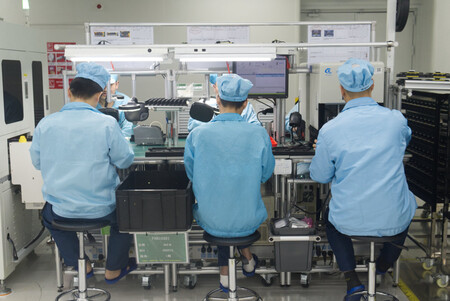
<span>Workers in a smartphone factory | Image: Xataka</span>Another case involves a young woman, who has chosen to remain anonymous, sharing her experience of leaving a demanding financial job in 2024. She now frequents a rented office to avoid disclosing her employment status to her family. For approximately 400 yuan monthly, she can spend her days in a “lie office” while actively searching for opportunities.
Dr. Biao Xiang , director of the Max Planck Institute for Social Anthropology in Germany, comments on this phenomenon, noting that “pretending to work is a refuge that young people find for themselves.” He emphasizes that this “lie” grants them a buffer against societal pressure. The owner of the Pretend to Work Company echoes this sentiment, stating, “What I sell is not just a job, but the dignity of not feeling useless.”
<img alt="Relaxing at Work" width="375" height="142" src="https://i.blogs.es/205696/ps---plantilla-portadas-xtk-177/375_142.jpeg"/>As reported, nearly 40% of the company’s clients are recent graduates seeking to fulfill their university requirements, while others utilize the space to escape family pressures. The average age of these clients is around 30 years , underscoring the growing trend among young adults.
The pandemic has placed significant strains on youth employment across China. Estimates suggest that the youth unemployment rate might have soared to 46.5% in 2023. Such alarming circumstances have led authorities to remove systematic listings of youth unemployment figures, further obscuring the true scale of the problem. With 12.2 million new graduates entering the job market, the likelihood of an increase in unemployment is concerning. The pressure on young individuals to secure employment is immense, prompting movements that critique traditional career ambitions.
Interestingly, the “Lie Down” movement (躺平), translates to living with less ambition in contrast to the highly competitive norms that once defined work culture, such as the notorious 996 work schedule . This shift promotes finding balance, prioritizing well-being over relentless ambition, advocating for a more moderate lifestyle, even if it means accepting lower-paying jobs.
The youth unemployment crisis in China requires immediate attention and innovative solutions. As students graduate into an uncertain landscape, striking a balance between societal expectations and personal growth becomes crucial in today’s fast-changing world.