
Who is winning the AI race ? At this point, we should have it more or less clear. We had it when Microsoft and Intel were profiled as the dominators of the PC world or when Apple and Google triumphed with their smartphones. But with AI, something curious happens: Things are very even.
Of course, in the field of popularity, OpenAI stands out, particularly with its product ChatGPT . Recently, the company claimed to be touching 700 million active weekly users, a truly remarkable figure that leaves its competitors behind. However, that metric is not definitive, especially when we have a significant unknown to address: what is the best AI model ?
It is Impossible to Know Today What is the Best Model of AI
No one can provide a clear answer to that question. Neither the companies, which continuously boast about their new versions, nor the benchmarks, which have become a useful but imperfect tool for evaluating the quality of these models.

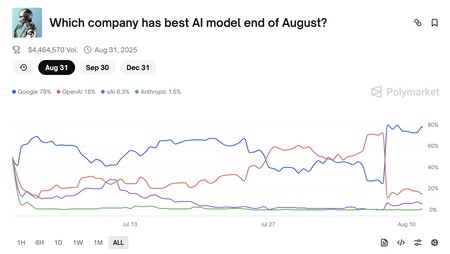
In Polymarket, people believed that the best AI model at the end of August would be OpenAI. After the launch of GPT-5, the perception changed.
The difficulty in answering this question is illustrated by Polymarket , a unique prediction platform where users bet on outcomes by voting for conclusions. When asked, “Which company has the best AI model at the end of August?” everything seemed to favor OpenAI. However, after the launch of GPT-5 , there was a noticeable shift: Google’s Gemini became the new favorite, with OpenAI collapsing to just 16% of the votes, trailing behind Grok (XAI) with 6.3% and Claude (Anthropic) with a mere 1.5%.
Polymarket may not be a particularly reliable indicator of anything, but it clearly demonstrates that The public perception of these models can vary significantly from their actual performance in areas like user numbers—where OpenAI still leads—or in benchmark performance, such as with Arc-Agi 2 (where Grok 4 beats everyone, including GPT-5).
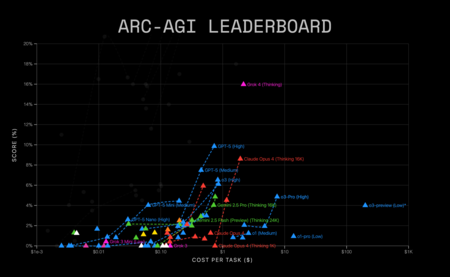
In the Benchmark of abstract thought ARC-AGI 2, Grok 4 significantly surpasses its competitors, including GPT-5, which exceeds Claude Opus 4. Source: ARC-AGI.
This makes it evident that two significant factors contribute to the challenge of determining which AI model is leading in this race. First, these tests often focus narrowly and specifically on evaluating abilities like programming or solving mathematical problems . Second, the models continue to improve, striving to outperform what their rivals achieved just days or weeks before. We continually observe new versions of models that are ostensibly better at programming, generating text or images, or solving specific types of problems, but there remains no consensual or definitive method to state, “this model is better.”
Moreover, users have their own personal preferences (as seen in Polymarket) when utilizing these models. Some individuals prefer Claude for programming, others lean towards ChatGPT for generic inquiries, while some choose Gemini for diverse topics and learning. None seems to emerge as the final “one-size-fits-all” model.
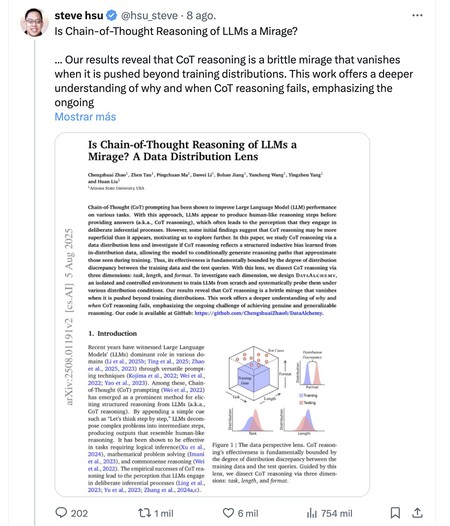
In a recent scientific study, researcher Steve Hsu concluded that the current path of generative models will not lead to AGI . Neither now, nor ever.
This leads us to a crucial reflection: the possibility of achieving General Artificial Intelligence (AGI) is still far from our grasp. Current models, designed to excel across various domains, are nowhere near that goal, and they continue to make mistakes, even though GPT-5 appears to have alleviated some issues, like hallucinations. Analysts like Gary Marcus have emphasized that we’ve been warned for over three decades: with present climbing techniques we won’t reach AGI.
This state of affairs leaves us with some intriguing conclusions.
David Sacks – a PayPal co-founder, founder of Yammer , and investor – analyzed the current market landscape and arrived at compelling insights. The five main companies developing foundational models — OpenAI, Google, Meta, Anthropic, and XAI — have not yet established a monopoly, which is potentially good news.
What exists instead is fierce competition not only among these five North American giants but also against numerous Chinese competitors and various startups that lack the resources for foundational models—yet aim to solve another pressing question: what is the Killer app of AI.
This represents great opportunities for startups to create success stories where AI can truly disrupt industries. For example, emerging companies like Cursor or Windsurf are leveraging the coding boom to capture significant interest among developers.
As we see, even leading AI companies boast that their latest models excel in programming or are better equipped than ever to tackle mathematical challenges. GPT-5, in fact, utilizes these two arguments to promote itself above the competition. While some benchmarks may support these claims, user perception will ultimately determine whether they meet expectations.
The debate between proprietary models (like GPT-5) and Open Source models is equally pertinent. As Sacks notes, Open Source models can deliver 80-90% of the capability at just 10-20% of the cost of foundational models, appealing to certain user bases.
This approach is favored by many in China, although it is noteworthy that the groundwork initially laid down has now been sidelined, and OpenAI has adopted it as a Plan B .
An Unsuspected Winner of the AI Career: Apple
Almost three years have passed since OpenAI debuted ChatGPT and during this time we’ve witnessed a frantic boom in AI technology. While these models have proven highly useful and unexpectedly effective in some scenarios, the true revolution resides elsewhere.
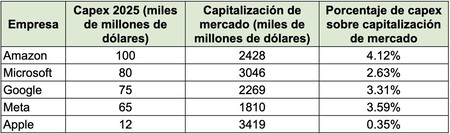
Projected capital expenses for Big Tech by 2025 are remarkable, exclude Apple, which seems skeptical about AI. At least, for now.
In contrast, most large tech firms are spending astronomical amounts to develop AI technologies. Many of these investments are currently unprofitable, with no clear timeline for when they might turn a profit. Yet, one major tech giant has stayed surprisingly in the background: Apple .
They might have chosen to step back and assess whether jumping on the AI bandwagon makes sense. Whether due to a strategic decision or a fortunate oversight, Apple has not engaged in major foundational models or established an expansive network of data centers.
Instead of betting everything on AI, Apple remains in a relatively low-profile stance, offering minimal AI capabilities in its operating systems and struggling with delays in Siri’s deployment.

Apple instead seems to be focusing on creating the Killer app of AI—one that could prove this technology is a Commodity—where the real challenge lies not in having the best foundational model but in effectively applying it.
The company appears to be betting once again on privacy and local execution of these models. Combined with Tim Cook’s obsession with augmented reality glasses, this could result in innovative products featuring AI. However, as of now, it remains speculation.
If this is indeed Apple’s strategy, it faces significant challenges. Particularly since it isn’t the only company pursuing this route. Google is developing its own augmented reality glasses equipped with AI, and that competition poses a long-term risk, not to forget the collaboration between OpenAI and Jony Ive. Moreover, Chinese tech firms are entering this space as well. Yet, Apple has a unique understanding of how to integrate software and hardware effectively.
The future remains uncertain, yet it is evident that no company is currently winning the AI race. That, in itself, is quite exciting.
Image | Xataka with ChatGPT
In Xataka | Is Tim Cook the Apple version of Steve Ballmer, while Nadella is akin to Steve Jobs?