
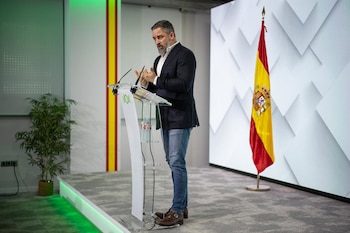
Santiago Abascal Critiques Ecclesiastical Silence on Immigration Policies
The president of Vox, Santiago Abascal, recently voiced stern criticisms regarding what he perceives as the “silence” of parts of the ecclesiastical hierarchy concerning the Spanish government’s immigration and gender policies. His remarks came after the Spanish Episcopal Conference (CEE) urged respect for the right to religious freedom in support of the Muslim community. This call was a direct response to a motion approved in Jumilla, which prohibits using sports facilities for purposes other than their intended use.
In an interview on the ‘Bipartisanship Stream’ on YouTube, Abascal expressed his feelings of being “perplexed and sad“. He mentioned that while he believes some bishops fail to oppose migration policies or what he described as “extremist Islamism”, they remain silent in the face of the Spanish government’s controversial gender policies. This silence, according to Abascal, raises questions about the commitment of certain ecclesiastical figures to the core principles of the Christian faith.
Critical Stance on Bishops’ Responses
Abascal didn’t hesitate to criticize the bishops for their apparent double standards. He referenced a past situation in Castilla y León, where Vox proposed to listen to the “fetal beat” as a means to highlight the fight against abortions. Abascal revealed that they faced immediate reproach from the Secretary General of the Episcopal Conference at that time. He lamented the bishops’ positions, especially regarding their stance on the Valley of the Fallen, a site steeped in historical and political contention in Spain.
He elaborated on his confusion, stating, “I am really perplexed and I do not know what to attribute this to.” Abascal questioned whether the bishops’ silence stems from fear of losing public funding received by the Church, or from a dependency on the financial aid associated with illegal immigration. He speculates that not all funds intended for helping those in need reach their destination, with some potentially supporting other factions or structures within society.
Concerns Over Institutional Integrity
The Vox leader addressed the sensitive issue of pedophilia within the Catholic Church, asserting that those cases contribute to the gagging of voices opposing government policies he sees as limiting freedom of expression. “We observe how certain liberticidal governments operate against faith, drawing attention to the double standards employed throughout the legal system.”
While he made it clear that his criticisms are directed at specific positions within the Episcopal Conference, he maintains a dual identity as both a Catholic and a political leader. “I will exercise my political responsibilities. If others do not do the same, they will have to answer for their inactions,” he stated firmly.
Abascal’s Vision for Spain’s Future
Abascal’s comments underscore a significant rift within Spanish politics regarding immigration and national identity. His passionate voiced concerns aim to push for a society that reflects traditional Spanish values while addressing contemporary challenges posed by globalization and cultural shifts.
By targeting ecclesiastic leaders in his discourse, he hopes to galvanize a broader movement that advocates for a more cohesive and stable society grounded in traditional principles. With immigration policies and gender issues remaining hotly debated topics, Abascal’s call for action could resonate with a sizeable portion of the Spanish electorate.
His perspective not only frames the conversation around these crucial issues but also offers a lens into how religious and political affiliations can intersect, often leading to complex dynamics in contemporary governance. The stakes are undoubtedly high, as the outcome of this debate may shape Spain’s socio-political landscape for years to come.
While Santiago Abascal continues to advocate for Vox’s vision of Spain, the future remains uncertain. The balance between upholding traditional values and embracing the changes of a modern world will be a pivotal challenge, demanding the attention and commitment of both political and ecclesiastical leaders alike.