
In 1943, a camouflaged ship departed from Australia to England carrying a highly secretive load : a platypus named Winston , intended as a diplomatic gift for British Prime Minister Winston Churchill . Tragically, the creature died during the journey, inciting 82 years of speculation that a German submarine was responsible. However, recent research has uncovered the true story behind Winston’s tragic fate.
Winston was not victim of enemy actions. Recent studies by Australian students have shed light on what really happened to Winston. By examining the archives of the naturalist David Fleay , who captured the animal, they discovered that historical temperature records revealed a different story. Winston died due to thermal stress while crossing Ecuador, not because of enemy attacks. During the crossing, temperatures exceeded 27 degrees Celsius for a week, surpassing the species’ survival limits.
<img alt="Abandoned pets are a rising problem. A Denmark Zoo has the solution: their animals are eaten" width="375" height="142" src="https://i.blogs.es/9ebefb/ps---plantilla-portadas-xtk/375_142.png"/>The reason behind sending an ornithorhinco. During World War II, Australia felt abandoned by Great Britain as Japan advanced in the Pacific. The Australian Foreign Minister Herbert Evatt knew of Churchill’s penchant for exotic animals and believed that an ornithorhinco, often dismissed as a taxidermy hoax , could sway military support in Canberra’s favor.
The trip that should never have happened. Winston was captured near Melbourne and placed in a specially designed container filled with hay, Australian stream water, and 50,000 worms for the 45-day voyage . David Fleay, the naturalist responsible for the expedition, opposed the journey from the start, noting that no ornithorhinco had ever survived a trip of such length, especially considering that exports of the species were prohibited.
The official cause of death. Upon discovering Winston dead in his container, Churchill expressed his “pain” to the Australian Prime Minister. To avoid any diplomatic incidents, the circumstances surrounding Winston’s death were kept under wraps for years. When the truth finally emerged, it was asserted that Winston died from the stress of the alleged attacks by German submarines—a narrative that Fleay himself supported at the time.
<img alt="Walking cats with belt is in fashion. We have asked an expert in feline behavior and is clear about what he thinks" width="375" height="142" src="https://i.blogs.es/602e05/pasear-gatos/375_142.jpeg"/>The logbook clues. Harrison Croft , a doctoral student at Monash University , accessed archives in Canberra and London that included testimonies from the platypus’s caretaker. “They conducted a sort of autopsy , and he was very clear: there was no explosion , and everything was calm on board,” Croft explained. An Australian museum team later digitized Fleay’s collection, where they uncovered the daily temperature records that ultimately revealed the real cause of death.
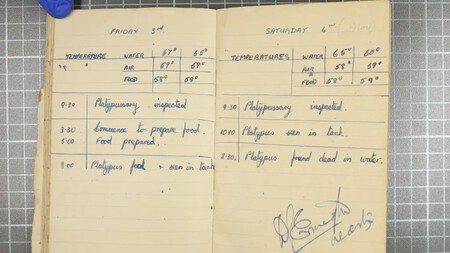
<span>Ship's logbook. Image: Australia Museum</span>Delicate diplomacy with ornithorhinco. In an effort to amend the situation, Australia attempted again in 1947 by sending three platypuses to the Bronx Zoo in New York. Sadly, one named Betty died shortly after arriving, but Penelope and Cecil thrived and became celebrities, attracting media attention . The public eagerly anticipated their reproduction, but after a brief four-day “romance,” things did not go as planned.
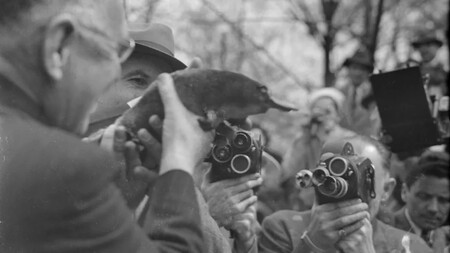
<span>Image: Australia Museum</span>The reproduction process of platypuses is particularly fascinating; they are monotremes, meaning they lay eggs despite being mammals. They are one of only five species of mammals that do so, the others being echidnas. The failure of Penelope to reproduce subsequently became a scandal of sorts at the time.
In 1957 , Penelope mysteriously vanished, and Cecil reportedly died the next day from a shattered heart, as per press accounts. Following these events, Australia instituted stringent bans on the export of platypuses. Over the past 70 years, only two platypuses have left the country, both to the San Diego Zoo in 2019.
Cover image | Yousuf Karsh and Michael Jerrard
In Xataka | If Spain believes that velutinas are a problem is because it does not know what the US has found: radioactive wasps