
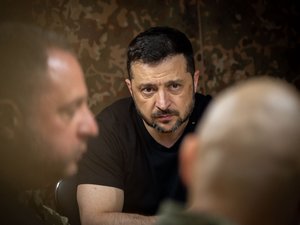
A few days before a summit between Vladimir Putin and Donald Trump, Ukrainian President Volodymyr Zelensky stated on Saturday, August 9, 2025, that no part of his country’s territory would be ceded to Russia to secure peace. This declaration underscores Ukraine’s determination to remain sovereign and intact amid ongoing hostilities.
Key Highlights
President Zelensky firmly rejected any notion of territorial concessions to Russia before the upcoming summit, fearing an agreement that compromises Ukraine absent its participation or input from European allies.
Donald Trump has suggested “territorial exchanges” as a way to end the war, a proposal met with fierce resistance from Kyiv, considering Russia’s demands include handing over four occupied regions and abandoning NATO aspirations.
On the ground, the Russian military has been making advances, recently capturing Iiablonivka in Donetsk, with further threats looming over Kostiiantynivka, Pokrovsk, and Koupiansk, as recent bombings have resulted in casualties.
Ukrainian President Volodymyr Zelensky made it clear that any concessions made to Russia would be completely unacceptable. The summit between Vladimir Putin and Donald Trump , scheduled for August 15th in Alaska, has raised concerns in Kyiv about the potential for an agreement brokered at Ukraine’s expense.
A Summit Without Zelensky
The meeting in Alaska comes as part of President Trump’s efforts to resolve the conflict that has engulfed Ukraine since the Russian invasion in 2022. Notably, this summit will occur without President Zelensky, who has been vocal about wanting a seat at the table.
“Any decision that would be made against us, any decision that would be made without Ukraine, would be a decision against peace,” Zelensky warned through social media channels, emphasizing that Ukrainians are unwilling to relinquish their land. Presently, approximately 20% of Ukrainian territory lies under Russian control.
The choice of Alaska as the meeting location is significant, given its proximity to Russia and its historical context — acquired by the U.S. from Russia in the late 19th century. Zelensky has also reached out to European allies, urging them to take clear steps to forge a united stance ahead of the discussions.
The Proposal for ‘Territorial Exchanges’
In recent statements, Trump’s mention of “territorial exchanges” has sparked considerable controversy. During conversations with European leaders, including French President Emmanuel Macron , it was reiterated that Ukraine’s future must involve Ukrainian voices. Macron emphasized that, “ Europeans will also necessarily be part of the solution because it is their safety .”
I just exchanged again with President Zelensky as well as with Chancellor Merz and Prime Minister Starmer. We remain determined to support Ukraine, working in a spirit of unity and by relying on the work undertaken …
– Emmanuel Macron (@emmanuelmacron) August 9, 2025
Spanish Prime Minister Pedro Sanchez also emphasized the need for unity among Western nations, aligning with Zelensky on the need for a common strategy moving forward.
Trump’s remarks, however, have left many questioning the specifics of these proposed territorial exchanges and what territory might be up for discussion. He characterized the conflict, stating, “It’s complicated,” highlighting the deep nuances and ongoing violence in the region.
The Current State of Conflict
As discussions unfold on the international stage, the situation in Ukraine remains dire. Recent advancements by Russian forces have included the capture of Iiablonivka in Donetsk , a key industrial hub. Russian military successes pose new threats to crucial Ukrainian settlements such as Kostiiantynivka and Pokrovsk , along with strategic areas like Koupiansk .
Recent bombings have resulted in the deaths of civilians in both Donetsk and Kherson , demonstrating the ongoing danger faced by civilians amidst military operations. In response to the escalating violence, Ukrainian authorities have initiated evacuations in eastern regions to safeguard children and families.
With the backdrop of sustained military actions and escalating diplomatic efforts, the stark realities on the ground continue to shape the narrative around the conflict. The upcoming summit holds both potential risks and opportunities, as world leaders grapple with the complexities of territorial integrity and national sovereignty. The outcome could redefine not only Ukraine’s borders but its future on the world stage, reflecting the broader geopolitical landscape that is constantly shifting.