
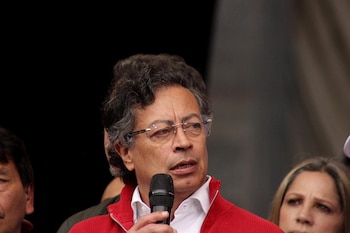
The president of Colombia , Gustavo Petro , made a significant announcement on Friday regarding his government’s new path toward peace negotiations with the Gulf Clan, a notorious drug trafficking organization. During a public appearance in the department of Córdoba, Petro outlined the conditions for these dialogues, emphasizing the importance of a legal framework that respects the principles of truth, justice, and reparation . This framework was presented to Congress earlier, serving as the backbone for the proposed negotiations.
Petro stated, “We have initiated conversations outside Colombia with the self-styled Gaitanista Army of Colombia,” the formal name of the Gulf Clan. The president noted that his administration has been effective in seizing more cocaine than any of its predecessors, asserting that his relentless pursuit of dialogue is intertwined with law enforcement efforts. “I do not tire of speaking; they tell me that I am a little fool, but we have seized more cocaine than any other government,” he remarked, highlighting both the complexity and urgency of the situation.
A critical element of Petro’s proposal involves touching upon the financial resources that sustain these criminal groups. He expressed a strong belief that without addressing the funding, “the war will not stop.” This assertion aligns with global strategies aimed at dismantling organized crime structures by cutting off their revenue streams. The president’s remarks suggest an ambition not only to engage in dialogue but also to incorporate economic strategies into his approach.
In his follow-up communications on social media, Petro sought to draw comparisons between his current negotiations with the Gulf Clan and the previous dialogues held by former president Álvaro Uribe with the paramilitaries . Petro emphasized, “It is as valid to engage with the self-styled Gaitanista Army as it was to talk to the paramilitaries during Uribe’s administration. There is no difference.” His aim seems to be to secure a more comprehensive framework that acknowledges the socio-political dimensions of Colombia’s drug trafficking issues.
The comparison also serves as a critique of previous administrations, suggesting that Uribe’s negotiations lacked the essential transparency and accountability that Petro aims to secure in his approach. He stressed that establishing a dialogue framework would not only target drug trafficking but also ensure “truth, justice, and reparation,” issues he accuses the previous government of neglecting.
The urgency of Petro’s actions has been underscored by recent escalations in violence linked to the Gulf Clan. In the past month alone, violent confrontations have led to the deaths of two Colombian soldiers. These troubling developments have occurred in various regions, notably in rural areas like Cañasgordas, Antioquia. Here, soldiers were reportedly ambushed, illustrating the escalating tensions and the complexity of reigning in armed groups.
From a broader perspective, Colombia’s security landscape remains precarious, especially given that the National Liberation Army (ELN) has intensified its operations after the breakdown of peace negotiations with the government. This resurgence indicates that the challenges of establishing lasting peace are multifaceted, requiring comprehensive strategies that encompass more than mere dialogues.
Petro’s administration clearly recognizes that effective communication with these armed factions is essential for achieving long-lasting solutions. However, it remains to be seen how these dialogues will unfold, especially in a climate rife with skepticism towards the outcomes of previous negotiations with violent groups. As Colombia grapples with its fraught history, the people’s hope for genuine reconciliation and peace is palpable.
In conclusion, the complexities surrounding Colombia’s efforts to negotiate with the Gulf Clan reflect the historical challenges of reconciling with criminal organizations. The push for truth, justice, and reparation is ambitious and highlights the Colombian government’s commitment to a new era of peace negotiations. With the stakes so high, the success of these efforts will significantly impact the future of Colombian society and its ongoing struggle against drug trafficking and violence.