
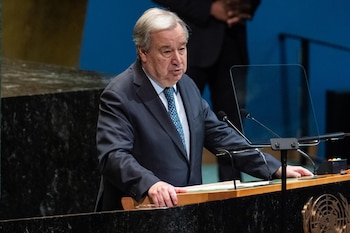
The UN Secretary General, António Guterres , has alerted this Friday that Israel’s decision to expand the offensive in the strip and take the city of Gaza “marks a dangerous escalation ” that will “put” even more in danger “civilians in the Palestinian enclave, including hostages .”
“(Guterres) is deeply alarmed by the decision of the Israeli government about ‘taking control of the city of Gaza’. (…) could aggravate the already catastrophic consequences of millions of Palestinians ,” said his attached spokesman, Stephanie Tremblay , in a statement.
The United Nations Chief , who recalled that the Palestinians in Gaza “continue to suffer from a humanitarian catastrophe of terrifying proportions,” warned that this new climb “will cause a new forced displacement , deaths and mass destruction , assuming unimaginable suffering for the Palestinian population .”
In this sense, he has reiterated his call for a ceasefire and the entry of humanitarian aid , while he has urged Israeli authorities to fulfill their obligations within the framework of international humanitarian law .
Thus, he recalled that the International Court of Justice (ICJ) declared that the State of Israel has the obligation to “end its illegal presence in the occupied Palestinian territories —which covers Gaza and the West Bank , including East Jerusalem —as soon as possible.”
“There will not be a sustainable solution to this conflict without the end of the illegal occupation and a viable solution of two states . Gaza is and must continue to be an integral part of a Palestinian state ,” he emphasized.
Growing Concerns Over Humanitarian Crisis in Gaza
The situation in Gaza has become increasingly precarious. Recent reports have highlighted the deteriorating conditions under which civilians are living. Basic necessities such as food, water, and medical supplies are becoming scarce, making daily life untenable for many residents. As humanitarian organizations struggle to provide assistance, the UN has urged for an immediate influx of aid to alleviate the suffering.
The Role of International Law
International law plays a crucial role in guiding how states conduct themselves in conflict zones. The Geneva Conventions outline the responsibilities of nations engaged in warfare to protect civilian lives. Guterres has emphasized that Israel must comply with these laws to ensure the protection of civilians. His repeated calls for accountability underscore the dire need for adherence to international norms, especially in such a volatile situation.
The Path to Peace: Two-State Solution
The concept of a two-state solution is often cited as the most viable path toward peace between Israelis and Palestinians. However, political divisions within both communities have complicated progress. Guterres’s remarks that Gaza must be an integral part of a future Palestinian state reflect the international community’s support for this approach. Despite its challenges, many believe that an equitable solution is necessary for long-term stability in the region.
Global Reactions and Diplomatic Efforts
The international community has responded with varying degrees of urgency. Countries across the globe have called for immediate ceasefires, and several have offered to mediate talks between Israeli and Palestinian leaders. The United Nations has been at the forefront of these diplomatic efforts, though the complexity of the situation often hampers progress. The need for timely and constructive dialogue has never been more pronounced.
The Human Element: Voices from the Ground
Amid the political discourse, the voices of ordinary Palestinians and Israelis often go unheard. The personal stories of loss, suffering, and resilience are crucial in understanding the human cost of this conflict. Many families on both sides live in fear, as the specter of violence looms large. Supporting local efforts to foster dialogue and reconciliation could be pivotal for any future peace initiatives.
In conclusion, as the crisis in Gaza escalates, the world’s attention must shift not just to the political landscape but also to the humanitarian needs of those affected. The urgent call for a ceasefire and adherence to international law embodies a collective hope for the future. The road to lasting peace may be arduous, but recognizing the humanity of all involved is the first step toward meaningful dialogue and resolution.