
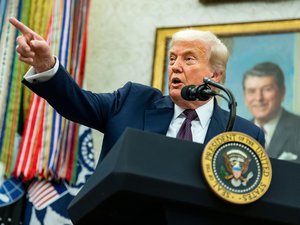
The recent implementation of new American customs duties has sparked significant discussion and concern among global economic observers. Effective from August 7 , these tariffs signal a decisive shift in President Donald Trump’s approach to international trade, aiming to reshape America’s economic engagements. Targeted at countries including the European Union , Japan , South Korea , and Switzerland , these tariffs range from 15% to 41% and are designed to “rebalance the exchanges,” according to Trump, who claims many countries are taking advantage of the U.S.’s economic position.
Key Takeaways
- New tariffs of 15% to 41% on imports began on August 7, affecting multiple nations.
- Mexico and China received some exceptions, while Canada , Brazil , and India face targeted increases.
- Economists warn of inflation risks and growth slowdown despite increased customs revenues.
Before the new tariffs, the U.S. had been applying an average effective rate of 18.4% on incoming products, marking the highest level since 1933 . The current adjustments could see this rate climb to approximately 20% , as analysts at Pantheon Macroeconomics suggest. These increased tariffs not only apply to consumer goods but also target critical sectors such as pharmaceuticals and semiconductors , potentially facing tariffs as steep as 100% .
A Boon for American Revenues?
President Trump recently proclaimed, “It is midnight!!! Billions of dollars in customs duties now flock to the United States of America,” on his social media platform shortly after the tariffs took effect. This statement underscores the administration’s expectation of utilizing these customs duties as a financial boon for the U.S. However, this initiative is not without opposition. Economists are raising red flags, especially as inflation had already climbed to 2.6% in June, with growth predictions for the second half of the year set at a mere 1% . While the administration might benefit from heightened revenue, the potential economic repercussions have led to growing concerns.
Countries Affected
Countries impacted by these new tariffs have been scrambling to react. For instance, Switzerland , facing a punitive 39% tariff , attempted last-minute negotiations with U.S. officials but ultimately achieved no significant reduction. The Swiss government promptly announced an emergency session to discuss potential ramifications. On the other hand, Mexico has maintained favorable customs conditions due to its close economic ties under the North American Free Trade Agreement (NAFTA).
In an interesting twist, the trade war standoff with China remains in a hold, with tariffs maintained at 30% on Chinese imports while Chinese tariffs on U.S. goods stay at 10% . This nuanced agreement allows both economies to continue dialogue while mitigating immediate financial impacts.
The Economic Outlook
In contrast, Canada recently faced an increase in tariffs to 35% , raising alarms among Canadian officials over the potential impact on trade. Canadian Prime Minister Mark Carney estimates that a significant portion of Canadian exports—over 85% —remain unaffected, but the ongoing tension still places strain on economic relations.
As the customs duties pressure increases, countries like Brazil and India have also presented challenges to the U.S. tariffs. Brazil filed a complaint with the World Trade Organization (WTO) and is focusing on aiding domestic companies to diversify their markets. In India’s case, the customs duties have been set to escalate to 50% over certain products, with Trump citing concerns over India’s trade regulations and its purchases of Russian oil amid sanctions.
Despite these challenges, many nations are beginning to adapt to the evolving trade landscape, seeking ways to lessen reliance on American markets. Interestingly, Trump’s strict stance on tariffs reflects a broader trend towards nationalism and protectionism, sharply diverging from the globalist approaches that have predominated in recent decades.
Yet, with the U.S. economy facing heightened scrutiny over inflation and slow growth, it remains to be seen how long this protectionist phase will last. The potential for economic conflict looms large, not just for the affected countries, but for the global economy as a whole, as nations reevaluate their trade relationships amidst uncertainty. The road ahead may well depend on how both sides approach negotiations in the months to come, balancing national interests against the need for sustainable international cooperation.