
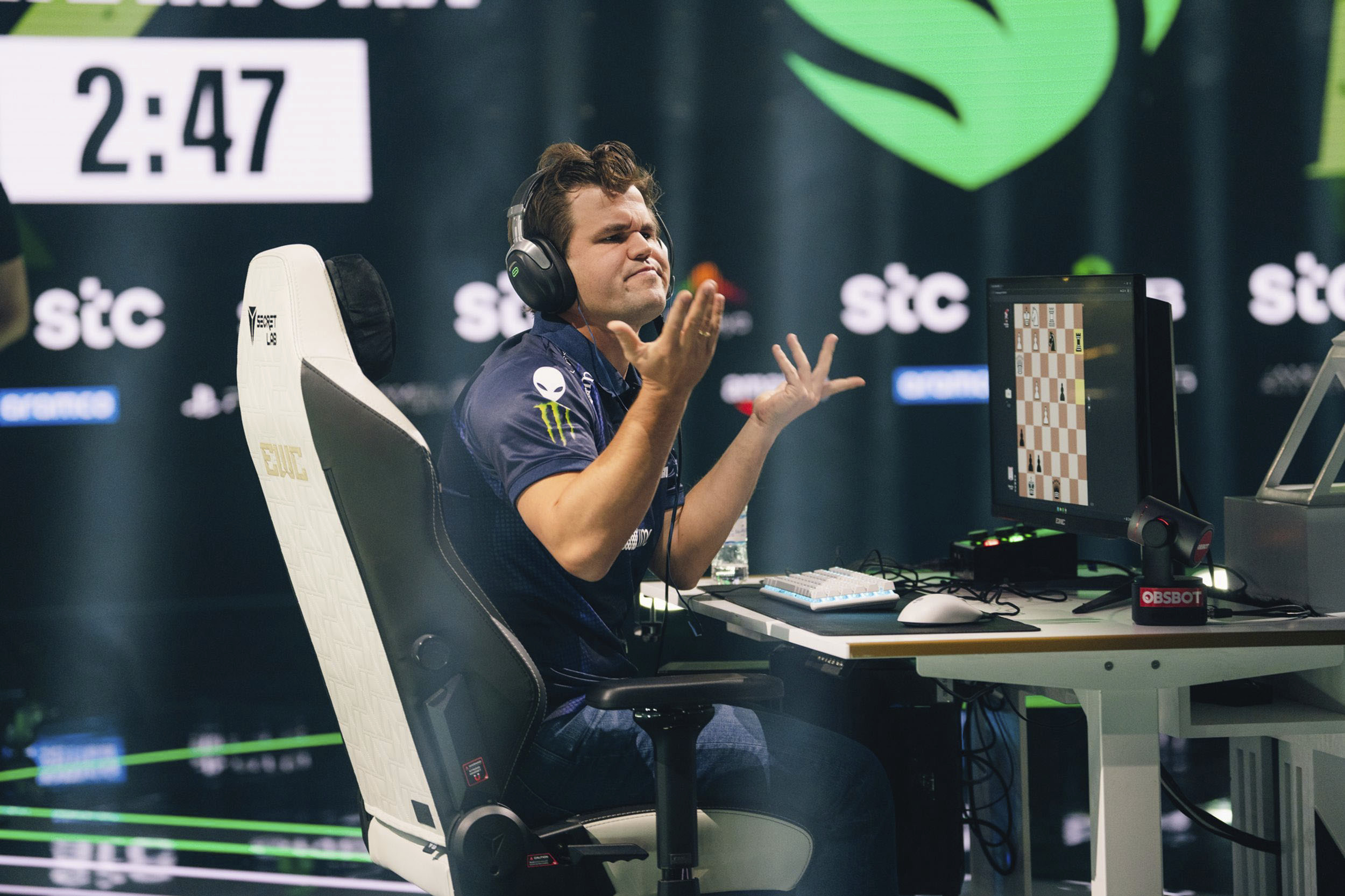
Readers not too young will remember the day Raúl Gonzalez commanded the Camp Nou to hush. The striker has had numerous imitators over the years, but so far, we had not seen such a gesture in the world of chess. From Magnus Carlsen, the reigning number one in the world, we’ve witnessed some table-pounding, but interaction with the audience had never before occurred. Until recently, in Riyadh, the Norwegian, despite his usual composure, became agitated at the ESports World Cup , a professional video game festival where chess shared the spotlight with popular titles such as League of Legends and Call of Duty.
“I got angry to see that they cheered for Nakamura when he was winning,” Carlsen explained later, maintaining his signature sense of humor. In Riyadh, the showmanship was arguably as vital as the gameplay itself. Nevertheless, his outburst did not backfire; the world’s number one returned home with $250,000 , adding yet another gold trophy to his collection. His performance in the final against Alireza Firouzja was so dominant it bordered on humiliating, as Carlsen even offered draws at points when he could have easily secured victory.
Chasing the Spectacular
Unsurprisingly, substantial money lies behind these efforts. In Saudi Arabia, the prize pool was nothing short of spectacular, reminiscent of the Freestyle Chess circuit, whose Grand Slam finals recently took place in Las Vegas. However, rumors suggest that billionaire promoter Jan Henric Buettner—who has been instrumental in promoting this random variant of chess where the piece positions are drawn—may be showing signs of fatigue.
Regardless, the constant search for innovative avenues in an immortal game persists. Chess endures partly because it adapts and evolves over the centuries, even as debates rage about whether the International Federation can effectively incorporate such modern ideas, particularly amidst pressures to reintegrate Russian teams into international competitions.
Considered about 1,500 years old , chess remains a storied game that has mostly retained its integrity. The emergence of the Internet provided a significant boost to its popularity. The pandemic brought a resurgence in interest, spurred in part by the popularity of shows like Queen’s Gambit. Yet, threats to its traditional format loom large, with digital platforms potentially functioning both as allies and adversaries.
Resistance to Change
However, not everyone welcomes this departure from chess’s foundational principles. Many traditionalists argue that two players facing off in different rooms, playing on separate boards through digital means, obscures the very essence of the game. The interaction was notably different in Riyadh, where competitors used computers and a mouse to make their moves. Amidst cacophony, the audience could cheer or jeer—though, given the venue’s nature, many spectators looked more like statues than engaged fans.
Carlsen, during a game.
The entertainment was top-notch, yet traditional chess enthusiasts witnessed events that left them aghast. For instance, Jan-Krzysztof Duda suffered a painful defeat due to a mouse slip. The classic wooden chessboard and its physical aesthetic conflicts with the digital interface required for eSports . Some matches concluded without time increments—remnants of a bygone era of analog clocks—leading to situations where matches ended because one player moved more rapidly, regardless of the game’s actual position.
This situation raises contradictions: the game is being modernized while stripping away technological advantages like digital clocks, which add critical seconds per move. The entire format seems contrived to create drama, akin to an action-packed Formula 1 race where only crashes draw the crowd’s interest.
“Chess is Not for Everyone”
Critics like remarkable Danish player Jacob Aagaard argue fervently: “The ongoing attempts to turn chess into a game that appeals to more people are illogical. Chess is decidedly not for everyone. If it is altered to cater to a larger audience, it ceases to be chess, a realm where we celebrate brilliance.” John Bartholomew, another eminent teacher, has voiced similar sentiments, noting that chess’s inherent difficulty might forever restrict its mass appeal. “A game requiring continuous effort and focus is at odds with today’s declining standards in those qualities,” he remarked.
While detractors of eSports initiatives may not favor them, many acknowledge that these platforms do not seek to replace classic chess. Instead, they serve to engage newcomers who may eventually develop an interest in traditional chess play. Online chess platforms have attracted millions; on Chess.com, for example, over 200 million users (albeit with duplicates), with an additional 100 million across other sites like Lichess.
Amidst the cash flow from these tournaments, the great players have benefited, earning prizes unavailable in regular competitions. The future of chess seems to hinge on balancing traditional values with modern innovations. Whether through the classic wooden board or a digital interface, one truth remains: chess will endure.