
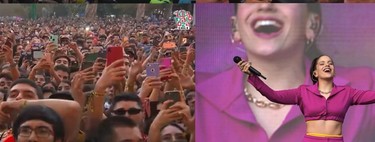
Rosalía at the Center of Controversy: Silent No More
In recent days, Rosalía has found herself at the center of a media storm. Accusations from fashion designer Miguel Adrover and a statement regarding the ongoing conflict in Palestine have stirred various reactions, spotlighting the complex relationship between artists and their political responsibilities in today’s entertainment industry.
The Accusation by Miguel Adrover
The drama began when Miguel Adrover, the recipient of the 2018 National Fashion Design Award , took to his Instagram account to air grievances against the popular artist. He leaked an email directed at Rosalía’s stylist, expressing his refusal to create a custom outfit for her due to her perceived ambivalence towards the situation in Gaza. Adrover stated that Rosalía had not openly supported Palestine, and he emphasized, “silence is complicity.” The timing could not have been more ironic, as this controversy surfaced amid the premiere of Adrover’s documentary, “The Designer Is Dead,” produced by C. Tangana , Rosalía’s former collaborator, at the Atlàntida Mallorca Film Fest .
Rosalía’s Response
Almost immediately following the accusation, Rosalía issued a statement clarifying her stance on the situation in Gaza. She stated, “It is terrible to see day after day how innocent people are killed.” Rosalía highlighted her unique approach to social media, differentiating her usage from that of other celebrities. Rather than using her platform to express everyday opinions, she insisted that her silence should not be construed as indifference to the violence. She argued that the focus should be directed “upwards” at those in power, rather than “horizontally” at each other.
Public Reaction: Has She Convinced Her Critics?
However, her statement failed to diffuse the tension surrounding the issue. Critics have accused Rosalía of ambiguity and a lack of a decisive stance, deeming her remarks too general. Many argue that she did not clearly define her position on a matter that inevitably requires explicit responses. Her mention of “horizontal signals” was particularly scrutinized, leading to a sentiment that her approach diverted attention from the pressing conflicts at hand. In the aftermath, commentators expressed a feeling of distance from the problem, with some suggesting that her statement would not be sufficient to enact real change in the ongoing conflict.
The End of Artistic Neutrality
The situation surrounding Rosalía amplifies a broader theme in contemporary art and culture: the vanishing of the neutral artist . As global conflicts such as the one currently unfolding in Gaza and the ongoing war in Ukraine rattle the public consciousness, audiences demand that artists take defined positions. Influencers and social commentators alike have observed that we are witnessing “the extinction of the neutral artist,” where art cannot exist in a vacuum anymore.
Art as Activism: A Historical Perspective
Traditionally, art and culture have been linked to political activism. Rarely could one dissociate the two without facing scrutiny. However, the mainstreaming of alternative art forms in recent decades—culminating in a culture that consumes entertainment at a growing rate—has altered this dynamic. The era of celebrity culture has led to a fragmentation of fame , with every detail of an artist’s life becoming fodder for public scrutiny. Artists are now compelled to articulate their perspectives on social issues, driven by an audience that is ever more aware of socio-political realities.
The Responsibility of Artists in Today’s World
The result of this new landscape is an ongoing expectation for artists to carve out clear positions on global issues. Audiences feel entitled to know where their favorite performers stand on prevailing conflicts. This expectation places artists in a challenging position, balancing personal expression with public accountability. Critics argue that to remain silent is, in itself, a political statement that could alienate fans or dilute the urgency of pressing humanitarian crises.
As Rosalía navigates this controversy, her experience serves as a potent reminder of the evolving role of artists in society. The pressure to engage with pressing political issues is mounting, and artists like Rosalía will invariably find themselves at the forefront of these discussions, whether they choose to be or not.