
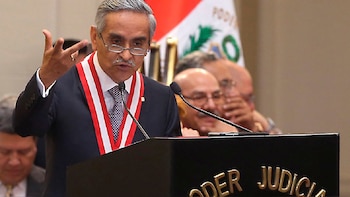
Political Turmoil: The Fate of Duberlí Rodríguez’s Popular Unity Party
The game Popular Unity, spearheaded by the former Supreme Court President Duberlí Rodríguez, has recently faced significant obstacles regarding its participation in the General Elections 2026. The National Jury of Elections (JNE) declared the judicial resolution that favored the party’s registration as “inejecutable,” thereby preventing it from participating in the looming elections.
In a dramatic turn of events, the Third Constitutional Court of Lima had initially declared the motion filed by Popular Unity to be valid after the JNE rejected its “provisional registration.” The intent was to ensure the party could compete in the 2026 elections, given that judicial resolutions surrounding its registration would, as anticipated, be resolved after the critical April 12 deadline for parties seeking registration.
Following this initial success, Popular Unity has sought the immediate execution of the ruling, requesting that the party’s registration be recognized without waiting for confirmation in a subsequent judicial review. This is akin to a precautionary measure that would allow them to enter the electoral fray.
On July 31, a judge agreed to popular unity’s request, instructing the JNE to recognize the party’s registration and permit its participation in the elections. However, by that point, crucial stages of the electoral calendar had already unfolded.
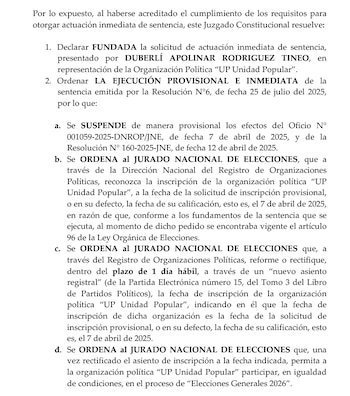
The primary contention for JNE in declaring the ruling ineffective lies in the fact that significant electoral milestones have already been met. The court stated, “Recognizing the registration of the Organizational Party as of April 12, 2025, implies suspending the milestones enacted after this date, which would indubitably disrupt the electoral calendar.”
The JNE also highlighted that a pressing milestone regarding the Reniec has already been fulfilled, whereby parties had to be registered by April 12.
“The compliance with the constitutional mandate to declare the registration of a political organization predates the concatenation of the aforementioned schedule,” noted Roberto Burneo, a JNE magistrate.
On another front, the JNE continues stressing the dissonance between the party’s requests and the court’s orders. They assert that the latter does not align with the constitutional mandates cited in the judgment.
“While the sentence orders the recognition of provisional registration for the political organization,” they said, “the resolution’s immediate action requires a fundamental reevaluation of the organization’s definitive registration date.”
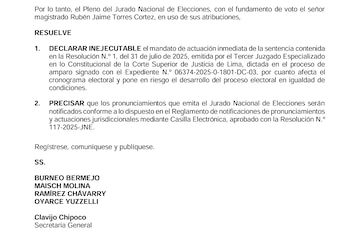
As a result, the JNE’s Plenary has firmly decided to deem the Judicial Power’s order as “inejecutable,” citing its potential risk to the integrity of the electoral process and the equal opportunities of other participating political entities.
This decision was collectively signed by magistrates Roberto Burneo, Martha Maisch, Willy Ramírez, and Aaron Oyarce. However, magistrate Rubén Torres chose to withhold his vote until the judicial process reaches a conclusive end.
The intricate developments surrounding the Popular Unity party emphasize the significance of adhering to established protocols within electoral frameworks and the formidable obstacles political organizations must navigate to gain recognition and access to electoral processes.