
In Spain, the disparity in retirement pensions for the self-employed versus salaried workers is a growing concern. As the nation grapples with economic challenges, it becomes increasingly evident that those who have worked as self-employed often find their pension significantly lower than their peers. This disparity raises questions about fairness and equity within the system.
For instance, consider an autonomous electrician working independently compared to a salaried electrician employed by a company. Both may earn similar monthly incomes and contribute to social security. The crucial difference lies in the contribution model. A wage earner benefits from their employer covering a portion of their social security payments, while the self-employed must shoulder the entire financial burden themselves. This financial disparity ultimately leads to a notable difference in their retirement pensions.
Difference in Pensions between Employees and Self-Employed. According to data from the Ministry of Inclusion and Social Security, the average pension for the self-employed stands at just €1,008.8 per month as of 2025. In contrast, salaried workers enjoy an average pension of €1,665.5 per month, highlighting a significant gap.
<img alt="Microjubilation: The recipe of generation Z against exhaustion consists in not waiting at 65 to retire" width="375" height="142" src="https://i.blogs.es/31d692/keegan-houser--q_t4scn8c4-unsplash/375_142.jpeg"/>This discrepancy is further amplified by gender inequalities. Self-employed men receive an average pension of €1,150.10 , while women receive only €863.97 . Such differences can be attributed to various factors, including years of contributions and chosen sections during their working lives.
On average, the monthly difference in retirement pensions between a salaried worker and a self-employed individual is €657.72 , translating to over €9,200 annually.
Salaried Salary and Contribution Base. In observable cases, both companies and employees share a percentage of the social security contributions . This shared cost is calculated based on the contribution base, derived from various deductibles. The greater the contribution base, the more substantial the retirement pension one can expect to receive.
Guy | Company | Worker | Total |
|---|---|---|---|
Intergenerational Equity Mechanism (MEI) | 0.67% | 0.13% | 0.80% |
Unemployment (Indefinite Contract) | 5.50% | 1.55% | 7.05% |
Unemployment (Temporary Contract) | 6.70% | 1.60% | 8.30% |
Fogasa | 0.20% | 0% | 0.20% |
Professional Training | 0.60% | 0.10% | 0.70% |
The Self-Employed Quote Based on Their Income. In contrast, self-employed individuals base their contributions on their net profit, rather than a regular salary. Given this, they can select their contribution base from defined sections. While many assume minimal contributions, which leads to lower retirement pensions , they can choose to quote a higher base for increased retirement benefits.
<pTo illustrate, if a salaried employee earns €1,600, their contribution base should be around €2,000. Conversely, to achieve a similar profit as the autonomous electrician, their net income needs to reflect earnings after expenses.
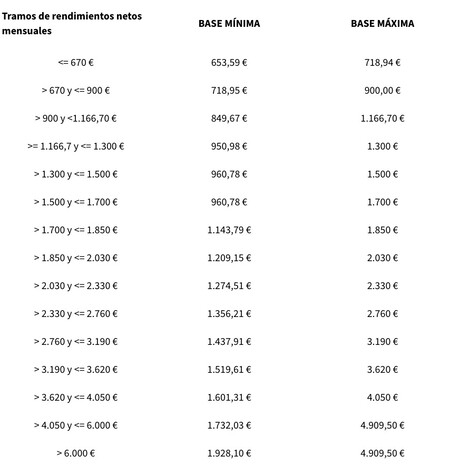
<span>Quotation sections and their minimum and maximum bases.</span>Regrettably, research from the Ministry indicates that 83.18% of freelancers in Spain are only contributing at the minimum level. This contributes to the *financial shortfall* many experience in retirement since just 2.1% of the self-employed contribute at levels similar to salaried workers.
Understanding the Challenges. While it may seem that self-employed individuals face *greater pressure * due to higher contribution obligations, it’s essential to note that their contributions closely mirror those of salaried workers. However, being responsible for both employee and employer contributions can create a more strenuous financial situation for the self-employed.
Consequently, to secure a more adequate retirement pension, many self-employed workers are advised to increase their contribution base steadily as they approach retirement, ensuring they contribute at higher levels for as long as possible.
<img alt="What are employment pension plans for self-employed and how they can help complete income after retirement" width="375" height="142" src="https://i.blogs.es/9e9636/micheile-henderson-zvprbbmt8qa-unsplash/375_142.jpeg"/>Pension Calculation and its Consequences. The eventual pension amount is determined based on the average contribution base over the last 25 years of contributions, or 300 months. If a self-employed individual’s contributions remain low, their resultant pension will also be notably lower compared to that of a salaried worker, who has benefited from a consistent salary.
Further compounding this issue, the distribution of pensions across Spain shows that, in over 60% of Spanish provinces, the average retirement pension for the self-employed remains below €1,008 monthly. Alarmingly, not a single autonomous retirement pension reaches the current minimum wage set in Spain for 2025 .
The disparities and financial pressures faced by self-employed individuals are pressing issues that deserve national attention. The current pension system needs reform to create a more equitable landscape for self-employed workers, ensuring that their hard work translates into a secure and sufficient retirement.