
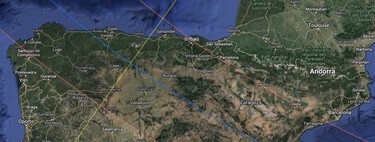
An exceptional cosmic carambola looms over Spain. Up to three solar eclipses will cross the Spanish territory in less than three years, starting with the most spectacular of all: the total solar eclipse of August 2026, which will obscure a third of the country. This rare phenomenon has prompted the government to mobilize thirteen ministries to create a contingency commission .
The eclipses trio. On August 12, 2026, a total solar eclipse will draw a 200 km line from the northwest to the southwest of Spain, entering Asturias and leaving through Castellón to cross the Balearic Islands just at sunset. The totality phase will last about two minutes on the central line. It will be the first eclipse of this type in the Peninsula since 1905.
<img alt="Seeing the Eclipse of Spain of 2026 will be a race against sunset: this map indicates where it will look" width="375" height="142" src="https://i.blogs.es/9c18f5/mapa-eclipse/375_142.jpeg"/>On August 2, 2027, the shadow of a total solar eclipse will enter through the Bay of Cádiz , crossing the Strait and leaving Almería . Ceuta , Tarifa , Cádiz Capital , and part of Málaga will enjoy almost five minutes of darkness in mid-morning. This will also be one of the longest eclipses of the century.
On January 26, 2028, Spain will experience an annular solar eclipse . The “Fire Ring” will traverse the country from southwest to northeast shortly before sunset, affecting areas from Huelva, Sevilla , and Córdoba to Valencia, Aragon , and parts of the Balearic Islands. The annularity will last about seven minutes, and outside the designated strip, the eclipse will be observed as a partial event.
The government mobilizes. “The eclipses trio will be an unprecedented astronomical phenomenon , which can *virtually only be seen in Spain* between 2026 and 2028,” asserted Minister Diana Morant. “In the Government , we are working to tackle the logistics and security challenges that this historic event will present.”
The magnitude of the event led the Council of Ministers to approve the creation of a special commission designed to organize and coordinate all actions. This commission will consist of representatives from thirteen ministries, encompassing sectors such as science and transport, as well as interior, defense, and ecological transition. The Secretary of State for Science, Juan Cruz Cigudosa , will head the commission, with plans to convene the first meeting by the end of August.
The challenges of the eclipses trio
The chaotic events during the eclipses of 2017 and 2024 in the United States have highlighted key concerns:
Congestions and accidents. The government estimates that hundreds of thousands, if not millions, of people will flock to witness the event. The band of totality for the 2026 eclipse will only make landfall in Greenland, Iceland, and the more populated, sunnier Spain. This could result in severe traffic congestion, blocking roads for emergency vehicles. The case of Oregon serves as a cautionary tale; during the 2017 eclipse, access roads saw overflow for three days.
Infrastructure overload in emptied Spain. Several prime observation locations are in rural or coastal areas with limited resources. The sudden influx of countless people could overwhelm basic services like drinking water, food, fuel, and restrooms. Mobile network congestion is also likely to occur, potentially leaving many people disconnected. The government plans to ensure “minimum services” at these observation points.
<img alt="We know exactly where and when the longest solar eclipse will occur in history: our great-great grandchildren will see it" width="375" height="142" src="https://i.blogs.es/b207ef/eclipse/375_142.jpeg"/>Extreme fire risk. The total solar eclipses will occur during summer, a time when drought and high temperatures are prevalent. This creates a perfect storm for potential wildfires, especially with thousands of vehicles parked in fields and gutters. A similar situation arose in Oregon during the 2017 eclipse, leading to evacuations due to fire hazards.
Pest of false eclipse glasses. Looking directly at a solar eclipse without proper eye protection can cause irreversible retinopathy . It is crucial to use glasses that meet ISO 12312-2 standards. Unfortunately, the market tends to become flooded with counterfeit products during eclipses. In 2017, Amazon recalled thousands of glasses due to safety concerns.
The first big photovoltaic blackout. Spain boasts 25% of its power from installed solar energy. A total eclipse could lead to a rapid drop in photovoltaic generation of up to 20 GW in less than an hour, followed by a sharp rebound. Managing this abrupt change will be a significant challenge for the Red Electrica , which will need to coordinate energy reserves to maintain system stability, as was done by European operators during the 2015 eclipse.
Tourist saturation and its effects. While astronomical tourism can be beneficial, it can also lead to overcrowding. Airbnb has reported an *830% increase* in rural accommodation searches as the date approaches, likely resulting in soaring prices for hotels and rentals, temporary gentrification , and possible displacement of regular tourists. Additionally, labor productivity may be affected as many take the day off to witness the phenomenon. The U.S. estimated nearly $700 million in losses during similar occurrences.
The unpredictable meteorology. The entire plan hinges heavily on weather conditions. A forecast of cloudy skies would result in a last-minute scramble to find clearer locations, exacerbating traffic issues. As astrophysicist Alejandro Sánchez cautioned, “Due to unpredictable weather, it’s as if we didn’t know the location of the World Cup final until just hours prior.”
The public cost and the environmental footprint. Organizing an event of this magnitude comes at a cost, from traffic management to health services, alongside the environmental impact caused by littering, natural habitat erosion, and carbon emissions from the mass movements of people. These issues will need to be evaluated by the contingency commission.
A historical opportunity
Despite the challenges, the trio of Iberian eclipses presents a golden opportunity for science and education in Spain. It will facilitate educational observation campaigns and STEM projects aimed at students, further establishing the nation as a leader in astrotourism . To centralize information regarding the events, the National Geographic Institute has launched a dedicated website.
Spain is gearing up for an event that represents both an extraordinary gift from nature and a rigorous test for public management. The urgency lies in learning from past mistakes and in proactive coordination, allowing the nation to focus solely on basking in the beauty of the celestial event. When the shadows of the moon engulf the peninsula in August 2026, all that will be left to do is look up (with the appropriate protective eyewear, of course) and enjoy a once-in-a-lifetime spectacle.
Image | The Fire Ring An annular solar eclipse (Kevin BairdCC)
In Xataka | A third of Spain will be completely dark for one or two minutes. The astronomical event of the century is approaching.