
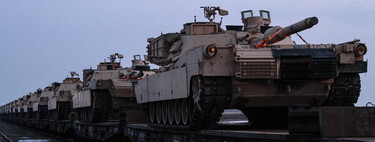
Assessing Russia’s Dwindling Military Resources in Ukraine
The vast Soviet arsenals that Russia leveraged at the onset of the invasion of Ukraine are now running out. According to an analysis from the Institute of the Kyiv Economy School, shipments from the main Russian military stores have plunged dramatically—from 242,000 tons in 2022 to about 119,000 tons planned by 2025 . This regression aligns closely with the levels recorded prior to the conflict, creating significant concern regarding the sustainability of Russia’s military operations.
The Context of the Problem
For decades, Russia has maintained enormous stockpiles of military equipment inherited from the Soviet Union. When the conflict began, Moscow quickly mobilized these vast inventories, refurbishing and deploying T-72 and T-80 tanks, some of which date back to the 1970s. In a stark reminder of historical military technology, even T-54 tanks, which first rolled off production lines in the late 1940s, have been sent to the front lines in Ukraine. This heavy reliance on outdated military hardware raises questions about the effectiveness of Russian forces in sustaining prolonged conflict.
The Current Reality
The recent analysis reveals that the highest quality equipment and those that were easier to refurbish were mobilized first. According to analyst Pavlo Shkurenko, Russia is currently sending significantly less material for reconditioning and repair than its repair stations are capable of handling. This sentiment suggests a troubling reality: Russia’s military reserves have diminished to critical levels.
The Desperate Solution
In a bid to compensate for this dramatic scarcity, the Kremlin has turned to its Asian allies in a substantial way. Current data indicate that 52% of shipments categorized as “explosive materials” destined for Russian arsenals in 2024 are originating from Nakhodka, a port in the Sea of Japan that is notably used by North Korea. Before the war, shipments were essentially nonexistent; however, this figure has since ballooned to 250,000 tons in 2024 . Ukrainian military intelligence chief Kyrylo Budanov has asserted that 40% of all Russian ammunition currently comes from Pyongyang, underscoring the extent of reliance on North Korean support to sustain military efforts.
Beyond North Korea
The analysis also highlights the likelihood of about 13,000 tons of explosive materials entering Russia from Iran, as suggested by their point of entry near the Caspian Sea. Not to be overlooked, China has emerged as a pivotal supplier for the Russian defense industry. Despite not providing direct military aid, shipments from Russia’s Eastern Border Regions to military production centers have nearly doubled since 2021, surpassing 3 million tons . This strategic partnership reveals the growing integration of Russian and Chinese military supply chains amidst ongoing conflict.
The Strategic Dilemma
On the surface, it may seem contradictory that Russia has grown dependent on external partners when it has sought to project a self-sufficient image. Military analyst Franz-Stefan Gady proposes that Moscow’s reliance on North Korean ammunition segments its supply strategy, allowing the Kremlin to maintain operational momentum on the front while preserving higher-quality Russian munitions for potential future confrontations with NATO forces.
What Is Coming
In light of these developments, Russia is projected to invest significant sums into future rearmament. However, its current situation starkly exposes the limitations of its local military capacity. The war that President Putin envisioned as a display of force has morphed into a prolonged test of resistance, wherein Russia finds itself increasingly reliant on allies and facing escalating economic consequences.
In conclusion, the landscape of military supply and logistics has changed dramatically for Russia. Once capitalizing on vast stockpiles left from the Soviet era, the Kremlin now finds itself scrambling for resources, dependent on external aid to continue its operations in Ukraine. As the conflict drags on, the strategic implications of this dependency could reshape not only Russia’s military capacity but also the geopolitical landscape in Eastern Europe.
Cover image | Kremlin
In Xataka | We already know what Russia’s trick is to multiply its drones: it is called “cooling units” and comes direct from China.