
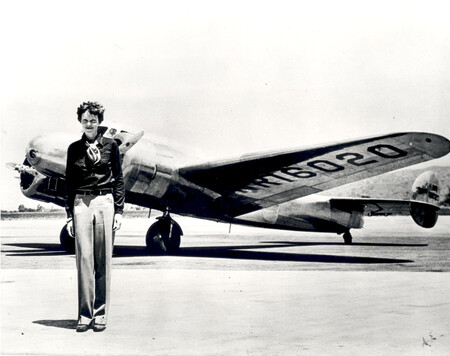
As we reflect on the pioneering spirit of aviation history, few figures stand out as prominently as Amelia Earhart . Born in 1897, she defied the norms of her time and became an international symbol of courage and independence. Her ambition wasn’t just to fly; it was to conquer the skies in a way that would inspire countless women to follow in her footsteps. While another aviation pioneer, Amy Johnson , made remarkable journeys between England and Oceania a few years prior, it was Earhart who aimed to complete one of the most audacious feats: to be the first woman to circumnavigate the Earth . Tragically, on July 2, 1937, during her flight, she vanished without a trace, leaving behind one of the greatest mysteries in the aviation world .
Eighty-eight years later, her legacy continues to captivate many. A new expedition aimed at uncovering the truth behind her disappearance is set to launch this coming November.
As a true trailblazer , Earhart is particularly remembered for being the first woman to complete two transatlantic flights: one as a passenger and another solo flight in 1932. She established several records for distance and speed among female pilots and worked tirelessly to promote women’s participation in aviation. By co-founding The Ninety-Nines , a women’s pilot organization, she advocated for women in a male-dominated industry, effectively changing the landscape for generations of female aviators.
The plan for her ambitious circumnavigation was not just to fly around the globe, but to take the longest possible route, covering approximately 47,000 kilometers . This well-publicized journey aimed to set record-breaking metrics and, in her words, to generate interest for an upcoming publication. The journey commenced in Oakland, California, with plans to head eastward through various international stops.
Funded by Purdue University , where she became an honorary member, Earhart modified her aircraft, a Lockheed Electra 10-E , to accommodate extra fuel tanks. This journey, which started on May 21, 1937, was meticulously documented. The itinerary included stops in several cities, showcasing a wide-ranging path across multiple continents.
| Departure Date | Departure Location | Arrival Location |
|---|---|---|
| May 21, 1937 | Oakland, California | New Orleans, Burbank, Tucson |
| June 1 | Miami | San Juan, Puerto Rico |
| June 2-5 | Caribbean Islands | Venezuela, Brazil |
| June 7 | Native | Saint-Louis, Senegal |
| June 10-15 | Central Africa | Dakar, Sudan |
| June 17-28 | India/Southeast Asia | Singapore, Java, Australia |
| June 29 | Darwin, Australia | New Guinea |
| July 2 | Lae, Papua New Guinea | — |
“Keep in mind that I am very aware of the dangers. I want to do it because I want to do it. Women should try to do things like men have tried. When they fail, their failure must be just a challenge for others.” – A letter written by Amelia before the last flight
Mystery shrouded Earhart’s final journey . During the last leg from New Guinea to Howland Island, only a few stages were left to successfully complete her circumnavigation. In their final radio communication, Earhart reported being close to her destination but unable to visually confirm it. This last communication occurred near the aircraft’s fuel limit, leading to the assumption of an accident due to insufficient fuel.
A rescue effort was immediately mobilized but ended fruitlessly on July 18, 1937. Despite advanced technology today, the challenges in pinpointing a plane lost in the vast ocean remain monumental.
In the wake of her disappearance, two primary theories emerged: that Earhart either ran out of fuel and crashed into the ocean or managed to land on a nearby uninhabited island, though neither theory has been definitively proven. Over the years, speculation has spiraled into various conspiracy theories, ranging from Earhart being captured by Japanese forces to the idea that she simply assumed a new identity.
New expeditions have been mounted to solve this enduring mystery. Notably, in 1940, a British expedition stumbled upon bones on Nikumaroro Island, leading to speculation about Earhart’s fate. However, forensic tests suggested they belonged to a male. Yet some research indicates the possibility of Earhart’s remains being found with up to 99% certainty .
The pursuit of the truth surrounding Amelia Earhart continues, with a new expedition planned for November 2025 . This time, the team aims to investigate recent satellite images which suggest a possible fragment of her plane. Steve Schultz of Purdue University expressed hope that uncovering her plane could fulfill her legacy and perhaps bring closure to one of aviation’s greatest mysteries.
As we approach the 88th anniversary of her disappearance, the world remains eager to see what the future holds for Earhart’s enduring legacy and whether the truth behind her disappearance will ever be found.