
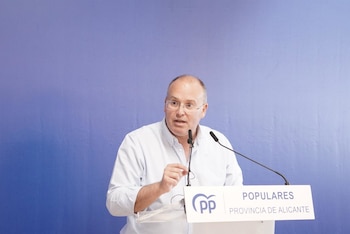
In a recent address, the General Secretary of the Popular Party (PP) , Miguel Tellado , expressed strong sentiments regarding the state of the Spanish government under Pedro Sánchez . He urged his party members to remain vigilant, warning, “ There is nothing more dangerous than an injured dog, than an injured Pedro .” This statement reflects the tense political climate and the perception of Sánchez as an increasingly desperate political figure.
The Current Political Climate in Spain
During his address in Tomelloso , Tellado characterized Sánchez’s leadership as faltering, highlighting that the president, whom he described as “without scruples,” was at a critical low point. He argued that Sánchez’s continued presence in power poses risks, stating, “He will want to die killing and he is able to do everything.” Tellado underscored the importance of not underestimating the Sánchez administration despite ongoing judicial issues surrounding it.
Tellado’s assertion that the current government is in a state of “ total and absolute agony ” conveys a sense of urgency among the PP. He emphasized the need for action as the public remembers the government’s failures. “We must deliver a historical defeat at the polls ,” he stated, aligning his party’s goals with the desire for a stronger governance system.
The Professional Downfall of Pedro Sánchez
According to Tellado, Sánchez’s presidency represents “the worst moment” for both Spain and the government. He noted that the political arena has transformed into a “ghost government,” only able to respond to demands from its coalition partners, hinting at an incapacity to govern independently.
Tellado drew attention to the legal troubles facing members of Sánchez’s inner circle, describing the implications for the Spanish political landscape. “ The Supreme Court says that Santos Cerdán must continue behind bars for his involvement in distributing public funds,” he claimed, emphasizing that the judicial system is severely undermining Sánchez’s credibility.
Hypocrisy and the Feminist Issue
In a striking revelation, Tellado accused Sánchez’s administration of being hypocritical regarding its feminist initiatives. He criticized notable public figures within the Socialist Party , particularly those implicated in scandals regarding the treatment of women. “Sánchez will be remembered for these frontal attacks on the dignity of women,” he added. This criticism stresses an increasing disconnect between the government’s proclaimed values and its actions.
Tellado firmly stated that, “ No one has done more damage to feminism than Pedro Sánchez and his gang,” hinting that the upcoming elections will be pivotal for women who feel disillusioned by the administration’s stance.
Attacks on Democratic Institutions
Expanding on his critique, Tellado addressed the erosion of democratic integrity within Spain under Sánchez. He referred to the “ institutional carcoma ” that he attributed to the president’s decisions, claiming that Sánchez has diminished the prestige of important institutions, including the State Attorney General’s Office and Banco de España . Such actions, he argues, have led to a government that aligns more with separatism and extreme left ideologies.
The Vision Forward
In contrast to Sánchez’s perceived failures, Tellado extolled the virtues of Alberto Núñez Feijóo , the leader of the PP, as a candidate for restoring credibility. He described Feijóo’s thirty years in politics without scandal as an asset, aiming for a project that promises to restore normality, democracy, and growth.
The PP has drafted a decalogue outlining their vision for governance. This plan includes commitments to democratize and regenerate government institutions, improve access to housing, alleviate fiscal pressures by lowering taxes, enhance employment conditions, and bolster healthcare provisions by increasing the number of doctors.
Conclusion
Tellado’s statements reveal a party prepared to capitalize on the perceived weaknesses of the current administration. With critical elections approaching, the Popular Party appears focused on leveraging issues regarding governance, the treatment of women, and the strength of democratic institutions. This discourse reflects broader concerns regarding the future of Spain’s political landscape, prompting voters to consider their choices carefully.