
China’s J-35 Fighter Jets: A Leap Towards Naval Power
While there is still no official announcement , recent developments around China’s J-35 fighter jets suggest that the program is making significant strides. A recent photograph published on Weibo and shared widely on social media platforms reveals two J-35 fighter jets flying in coordinated formation. What sets these aircraft apart from previously seen prototypes are their construction numbers , “0011” and “0012”, which are clearly visible on the fuselage. This is a compelling indication that the J-35 program has transitioned into a limited series production phase , a critical step towards operational deployment.
LRIP Inspections and Emblems
The image appears to have originated from an official channel of the Chinese Navy , further reinforcing its authenticity. The presence of specific details, such as national emblems on the vertical fins, a tactical gray paint scheme, and a shark motif on the tail, also supports this theory. Aviation specialist Andreas Ruprecht, who has been quoted in War Zone , has pointed out these visual signals in Chinese naval aircraft designs.
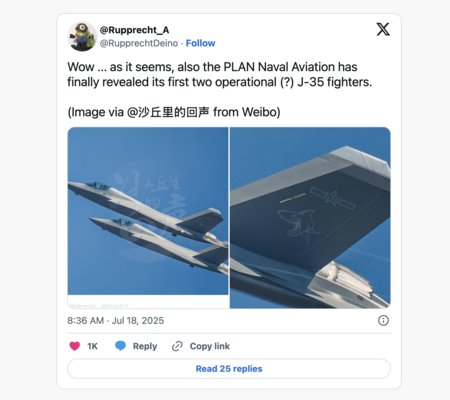
<span>Click to see the publication in X</span>The pilots of these jets carry bright blue helmets —a clear indicator that they are affiliated with the J-15 aviation unit, known for its frontline capabilities. This further implies that these J-35 jets are likely to have been assigned to the Navy and are undergoing validation tests prior to their impending service entry.
Evolution from FC-31 to J-35
The J-35 is an evolution of the FC-31 model, which was developed by Shenyang as a more compact stealth fighter compared to the J-20. The first navalized prototype took flight in 2021 , with subsequent iterations seen in 2022 showcasing a low-visibility gray color scheme. Blurry images of a potential third prototype surfaced in 2023 . With the latest “0011” and “0012” specimens, it is evident that these units are being configured for initial serial production.
This aircraft is engineered for operation from aircraft carriers equipped with catapults , such as the Type 003 Fujian, indicating a significant advancement in China’s naval capabilities. This evolution follows years of training in land facilities designed to simulate Catobar operations.
Engines: WS-19 vs. WS-21
The specific powerplants for the J-35 remain a topic of speculation. Some experts suggest that the land variant, known as the J-35A, might utilize the final WS-19 engine, recognizable by its darker nozzles. Conversely, the naval variants, which have clear nozzles, could potentially be powered by the WS-21 , an evolution derived from the WS-13 used in initial prototypes. Until official confirmation is provided, it can be inferred that Shenyang is continually tweaking the engines in line with the program’s progress.
Both aircraft in the recent photographs are equipped with a Luneburg lens attached beneath their fuselage. This radar reflector can be deployed when full observability is not a concern, or it can serve to obscure the true design of the aircraft from third-party observation.
Testing on Aircraft Carriers
Currently, there is no photographic evidence that supports rumors of successful testing on aircraft carriers. However, if the aircraft are indeed under Navy control, embarked trials would naturally be the logical progression, unless they have already been underway. Speculation is circulating about a possible public presentation in September , coinciding with the 80th anniversary of the Japanese defeat in World War II. It remains to be seen whether Beijing will seize this opportunity to showcase its advanced capabilities.
<img alt="Mazda wants to reinvent the electric car with an electric car that is not entirely electric. In China they have improved the idea" width="375" height="142" src="https://i.blogs.es/87c2cd/bateria-mazda/375_142.jpeg"/>The J-35 represents another critical piece in the expansive puzzle of China’s airborne military capability. It enhances the country’s growing emphasis on a complex naval air wing, competing with the United States on multiple fronts. As China explores the full potential of this new generation of aircraft, the timeline for achieving operational capabilities remains an outstanding question.
Images | Thomas Aseyroux | 沙丘里的回声 (Weibo)
In Xataka | There is a city that maintains much of Russia’s economy in times of war. And it is on the Chinese border.