
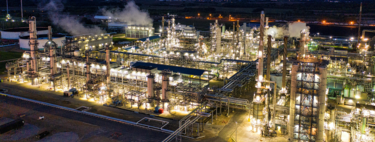
“The oil market is misleading.” This alarming statement comes from analyst Javier Blas in a recent article for Bloomberg, where he highlights a transformation that has fundamentally altered the seasonality of global oil consumption. What was once characterized by winter peaks is now witnessing summer as the period of highest crude demand . Against this backdrop, Poland finds itself at a watershed moment, thanks to the discovery of the largest conventional hydrocarbon reserve in its history, located in the Baltic Sea.
A submerged treasure. The Canadian company Central European Petroleum (CEP), supported by Norwegian investments, has announced the discovery of the Wolin Este site (We1) , positioned merely six kilometers off the Polish coast.
TVN24 reported that the newly discovered site comprises approximately 22 million tons of oil and 5 billion cubic meters of natural gas . The total estimate for the concession stands at 33 million tons of crude oil and 27 billion cubic meters of gas . According to analyses cited by the BBC, this equates to around 200 million barrels of oil , marking it as a strategic find both in volume and location .
It doesn’t change everything, but it changes a lot. Currently, Poland consumes about 700,000 barrels of crude oil daily, yet local production hangs around 18,000 barrels . Therefore, a discovery capable of tripling national production signifies more than just good news; it encapsulates a potential turning point . According to CEP’s Executive Director, Rolf Skaar, exploiting the Wolin site could increase Poland’s production threefold, as reported by TVN24.
Moreover, the oil found has an API index of 33.4 , classifying it as light crude, which is more economical and easier to refine. This discovery becomes particularly critical as Poland distances itself from Russian energy post-Ukraine invasion. The country has already connected with Norwegian gas through the Baltic Pipe , enhanced its LNG import capacity from Świnoujście , and diversified crude supply via Naftaport in Gdańsk. Wolin seems poised to change the dynamics of Poland’s energy reliance.
From the finding to extraction. The concession of Wolin covers 593 km² , with drilling conducted by the specialized platform Noble Resolve , reaching a vertical depth of 2,715 meters . Geological analysis confirmed the presence of a 62-meter hydrocarbon column in the primary dolomite formation (CA₂), as detailed by Gospodarka Morska.
CEP has already invested around 200 million Zlotys in seismic studies and drilling and is now seeking both Polish and international partners for the extraction phase. Talks with companies such as PGNIG (now part of Orlen ) have resumed following the state’s energy merger.
International Resonance. The Wolin discovery comes as the international crude oil market grapples with uncertainties. As reported by Reuters, Brent futures recently closed under $70 . The backdrop is the European Union’s new sanctions against Russia, which prohibit importing refined products from third countries using Russian oil, like India. Analysts believe alternative supply routes will emerge, yet concerns linger about the impact on the diesel market, a fuel harder to replace. This scenario adds further weight to the notion that new deposits in Europe represent not only an energy advantage , but also a geostrategic asset .
And now what? While the new site won’t single-handedly solve Poland’s energy dependence, it has the potential to mark a significant turning point. Energy expert Wojciech Jakóbik emphasizes in the BBC that the find “will strengthen energy security , provided that estimates are confirmed and the necessary infrastructure is developed.”
It remains uncertain whether a new pipeline will be constructed or if existing infrastructure will be utilized. Meanwhile, CEP is engaged in discussions with multiple stakeholders and, as Jakóbik notes, the project will require firms willing to take on “greater risk and have investment capacity.”
An energy window in convulsive times. The discovery in the Baltic Sea coincides with the global market entering its peak demand season, as highlighted by Bloomberg. The traditional seasonal dynamics of crude consumption have shifted: it’s now summer that sees the highest demand peaks. The pressing question is whether Poland can seize this pivotal opportunity without repeating past mistakes. The window is open, but it is not everlasting.
Image | Pexels
The discovery heralds a new era for Poland, potentially steering the nation toward greater energy independence while navigating the complexities of global oil markets. As the country stands on the brink of this transformation, careful planning and partnerships will be vital for ensuring a sustainable and lucrative future.