
Among the mountains southwest of Pyongyang , a new building has become the last great mystery of North Korea . It appears in a satellite image captured on June 9 by Planet Labs , indicating an annex as striking as disconcerting . There are no windows, only a long and high structure that seems designed for something that is preferred to keep hidden. Missiles? Anti-aircraft systems? The first hypotheses are already on the table, but the answers, as always, are much more difficult to obtain.
A complex with decades of history. The Missile Factory Chamjin is not just any installation. American spy satellite files already mentioned it in the 1960s as a nerve point of the North Korean missile program. It is officially known as Thaesong Plant and hides in a narrow valley, surrounded by peaks and safeguarded by control stalls and anti-aircraft nests. There, between tunnels excavated in the mountain and industrial pavilions, some of the rockets that fortify the military might of the country are assembled.
The great remodeling of 2023 and 2024. For decades, the western part of the Missile Factory Chamjin remained almost intact , with aged industrial pavilions and deteriorated ceilings. Everything changed in recent years when the largest of these buildings underwent a complete renewal , including a new roof that caught the attention of analysts. That movement was just the beginning. In July 2024 , the works intensified: three industrial ships and several minor buildings were demolished to give way to larger structures.
It was during this period that the renewed pavilion incorporated the annex that today concentrates all eyes, an addition that breaks the known silhouette of the factory and suggests a new stage in the complex.
What hides behind the annex? The new annex does not go unnoticed. With its 65 meters long, 18 meters wide, and about 15 meters high—measures calculated by researcher John Ford at the James Martin Center for Nonproliferation Studies —the structure seems designed for tests with long and heavy objects.
The specialist warns that the design does not fit at all with the needs of the largest rockets of the North Korean arsenal. One of the most solid theories points to the anti-aircraft systems Pongae 5 or Pongae 6 , which Pyongyang has promoted in recent months without still showcasing them in public. The annex, according to this reading, could be destined to test the vertical deployment of the launch pipes of these systems or even assemble the vehicles that transport them.
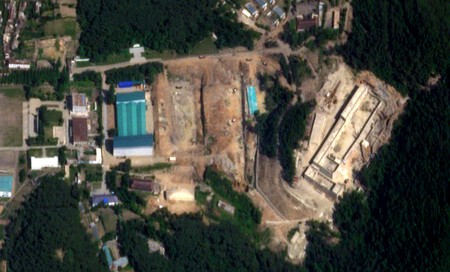
For now, everything is interpretation . North Korea rarely shows what happens in its military factories, and satellite images only offer fragmented clues. However, judging by the architecture and location of the new building, analysts agree that its function is linked, in one way or another, to the heart of the missile program.
The shadows of military cooperation. The expansion of the Missile Factory Chamjin does not happen in a vacuum . Since Moscow and Pyongyang reinforced their military ties, North Korean factories have experienced accelerated modernization. Analysts like Colin Zwirko from NK News point out that the rhythm of construction in key facilities is related to the supply of weapons to Russia for the war in Ukraine .
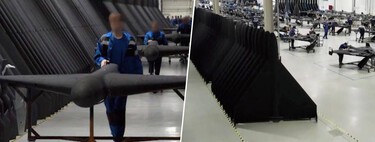
Missiles, artillery projectiles, and industrial components have left these plants for Moscow , and the money received could be financing improvements such as the new annex.
The propaganda narrative and the role of Kim Ju-Ae. In North Korea, visitors to missile factories are not just technical inspections; they are carefully crafted messages. In early 2023, Kim Jong-un appeared at the Thaesong plant accompanied by his daughter Kim Ju-Ae , an image that toured state news. Since then, Kim Ju-Ae has become a recurring face of military propaganda. Analysts suggest this is an attempt to convey that the arms program is a shield for the safety of new generations.
Images | Kremlin | Planet Labs (Via Defense News)
In conclusion, the recent developments at the Missile Factory Chamjin reveal a complex interplay of military ambition, international partnerships, and propaganda strategies. As analysts continue to speculate about the true purpose behind the newly constructed annex, it is clear that this facility plays a significant role in North Korea’s ongoing pursuit of advanced missile technology. The expansion reflects not only technological advancements but also a broader narrative surrounding Pyongyang’s military capabilities and its quest for recognition on the global stage.