
China’s High-Speed Rail Revolution: From Expansion to Optimization
China has achieved an unparalleled milestone: it has constructed the largest high-speed rail network in the world within a relatively short timeframe. However, mere expansion is not enough. The new challenge lies in refining this existing infrastructure to enhance efficiency , connectivity, and overall utility for the economy. This requires less flashy, yet equally ambitious, measures.
To Grow Quickly, but Wisely
Between 2021 and 2024, China aims to add an astonishing 10,000 kilometers to its high-speed rail network. While this figure is certainly impressive, it is no longer the sole measure of success. The Ministry of Transportation has clarified that the goal is not simply to expand the rail map but to maximize the network’s potential. In fact, China aims to reach 50,000 operational kilometers by the end of 2025. Currently, the network spans 48,000 kilometers , representing over 70% of the world’s total, and connects 97% of cities with populations exceeding 500,000.
Millions of Travelers with Room for Improvement
In just the first half of 2025, China’s high-speed rail system facilitated 2.24 billion passenger trips . Although this number is remarkable, officials emphasize that there is still much work to be done. The focus now is on making the system not only more comfortable and predictable but also better integrated with other modes of transportation—be it urban metros or airports.
High-Speed Rail Meets Logistics
China’s ambition extends beyond transporting passengers. There is a growing focus on adapting high-speed trains for freight transport , creating interconnections with airports and seaports, and integrating the entire transport network into the production supply chain. This evolution is essential for enhancing the country’s competitive edge in global markets.
Future-Proofing Rail Technology
As China maintains its existing rail network, it is also developing next-generation trains, including magnetic levitation (maglev). These innovations are not intended to replace current systems; rather, they are meant to prepare for an era where speed , autonomy , and sustainability take precedence. Prototypes in cities like Qingdao have already achieved speeds of 600 km/h .
Impressive Figures and Robust Safety Measures
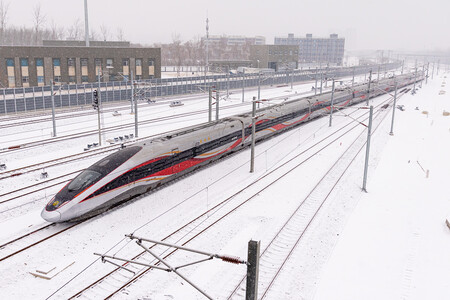
Transporting millions of passengers daily with punctuality is a significant achievement, but doing so without major incidents over many years is even more remarkable. China has developed a rail network that not only operates at high speeds but is also designed to withstand earthquakes , storms , and overloads . According to official reports, since 2012, no serious accident has been registered on this extensive high-speed network, making it one of the safest rail systems in the world.
Strategic Centralized Planning
In a world where many countries grapple with chronic delays in transportation systems, China has adopted a clear strategy characterized by centralized decision-making, significant investment, and state control of the process. While this system is not without its drawbacks—issues like cost overruns and questionable decisions exist—the success achieved in deploying and integrating the high-speed rail network cannot be overlooked.

A Mature Network Facing Major Challenges
As the world’s foremost high-speed rail network continues to expand, China is now focused on more than just adding cities. The pressing challenge is to ensure that this colossal infrastructure operates efficiently, minimizing errors while meeting increasing logistical demands. The era of sheer expansion is giving way to a new focus on precision and efficiency in operations.
In conclusion, China’s approach to optimizing its high-speed rail network—involving an intricate interplay of strategy, technology, and logistics—highlights the nation’s commitment to merging speed with utility. As investments continue and innovations unfold, the focus remains firmly on creating a system that not only serves millions but also enhances national competitiveness in an increasingly interconnected world.