

In July 2002 , a group of Moroccan soldiers landed on the uninhabited Perejil Islet, which is situated merely a few meters from the North African coast. This military incursion triggered an immediate response from Spain, aiming to restore the status quo . The event escalated into a brief but intense military crisis, straining diplomatic relations between the two nations. It ultimately required international mediation, leading to the demilitarization of the islet and a tacit agreement to maintain it free of official presence—an arrangement that lingers today within the delicate diplomatic context in the Strait of Gibraltar.
Recently, however, tensions have re-emerged .
The fragile political strip of the Western Mediterranean—the Strait of Gibraltar —is back at the center of a geopolitical contest between Spain and Morocco. This resurgence is marked by a tapestry of diplomatic gestures, operational maneuvers, and provocative symbolic acts that have revived old anxieties, particularly surrounding Perejil Islet. Reports from El Confidencial indicated a growing “discontent” from Morocco.
An apparent catalyst for this resurgence was the recent attendance of a delegate from the Polisario Front at the National Congress of the Popular Party in Spain. This participation sparked a series of Moroccan responses, including the unexpected closure of customs between Ceuta and Melilla. Further complications ensued with an official letter from the Istiqlal Party demanding the Popular leader’s alignment with Morocco’s Autonomy Plan for Western Sahara. Additionally, the Committee for the Defense of the Causes of the Kingdom , an organization linked to Moroccan intelligence services, re-emerged in Castillejos , led by the controversial former senator Yahya Yahya.
Amidst this backdrop, an increasing wave of nationalistic fervor has been detected. In an interview reported on El Español, the aforementioned committee proclaimed its intent to hold a symbolic meeting on Perejil Islet, aiming to assert a claim for “territorial unity” under the patronage of King Mohamed VI.
Even though an actual landing did not occur, the event was meticulously orchestrated. Photographic evidence showcased the islet in the background, nationalist slogans , and direct provocations concerning the policies of the Popular Party. The proximity of these events to the anniversary of Morocco’s occupation in 2002, aligned with the release of a documentary miniseries on the incident—which Morocco had unsuccessfully attempted to censor—underscored the symbolic weight of the gesture.
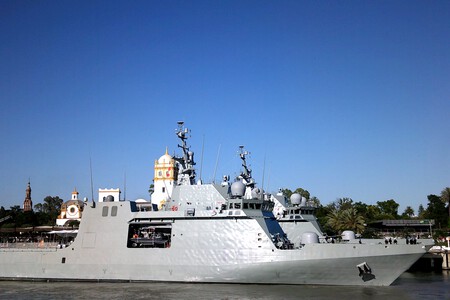
<span>Furor Frigate</span>In response, Spain took precautionary steps. The General Staff of Defense , as reported by Europasur, deployed the maritime action vessel ” Furor ” near Peñón de Vélez de la Gomera and Alborán Island, integrating this into routine naval operations aimed at coastal control.
This vigilance concerning Spanish sovereignty over the islands along the African coastline is essential not only for border security but also for maintaining territorial integrity amid escalating Jordanian maneuvers—theatrical in nature—that aim to test Spain’s diplomatic resolve.
A clear parallel exists between the current scenario and the tumultuous events preceding the 2002 Perejil Crisis . Back then, Morocco leveraged societal turmoil in its favor to stage a territorial occupation. Present-day phenomena, including disturbances in the Pacheco Torre , present opportunities for Rabat to exploit perceived weaknesses within Spanish society.
Morocco appears eager to utilize Spain’s domestic vulnerabilities as leverage to reinforce its claims regarding Western Sahara and its ambitions toward Ceuta, Melilla , and beyond.
<img alt="France needs to cut 40,000 million euros. And he has decided to start for something sacred in Europe: the holidays" width="375" height="142" src="https://i.blogs.es/a521ca/2873218280_494fc415a3_k/375_142.jpeg"/>In summary, while the Spanish government publicly endorses Morocco’s Autonomy Plan for the Sahara , factions such as the Popular Party are gravitating toward stances aligned with United Nations resolutions . This situation fuels a debate that Morocco adeptly employs to condition diplomatic alliances and showcase its strength.
The recent reactivation of Moroccan nationalist groups , driven by figures in close proximity to power, and their explicit threats directed at Spanish political figures represent a broader strategy of hybrid pressure. While the Moroccan flag does not yet adorn Perejil, the mere attempt to assert claims over it serves as a poignant reminder that the line between provocative gestures and genuine diplomatic crises remains fragile.
Image | EFORGE, General Staff of Defense, Carlosvdehabsburg
In Xataka | The Strait of Gibraltar was vastly different eight million years ago, exhibiting remarkable geological variations.
In Xataka | A proposed 15-kilometer tunnel aimed at connecting the Strait of Gibraltar was presented as a frontier-defying concept over 100 years ago.